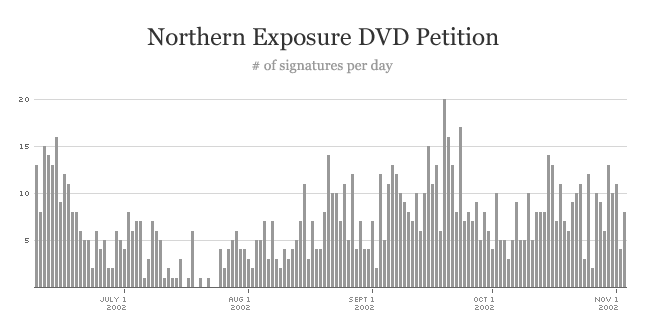
1000 Northern Exposure fans can’t be wrong

After an interesting four months, I’m going to close off the Northern Exposure DVD petition at 1000 signatures. This should only take another day or two – so sign up now. After I close the petition, I’ll post an overview of what happened and what will become of it.


Brandstorming

Mammoth consulting firm KPMG has changed their name to BearingPoint. They are trying to dodge the accounting scandal stigma by separating their consulting from their auditing components.

Enjoy a few highlights from a corporate video on the re-branding:

“We make things happen. We don’t bring problems, we bring results.”
“We integrate and collaborate.”
“We deliver on our promises with an attitude of ‘whatever it takes’.”
“We have a presence – an intensity.”
“We know how to think on our feet and we know how to make it happen – now.”
“We don’t walk – we run.”

You just can’t make stuff like that up (well, eNormicom can).

This is obviously reminiscent of Andersen Consulting’s name change to Accenture (“Innovation Delivered”). Apparently Andersen was forced to change their name due to a court ruling. They too have embarrassing corporate videos on their site highlighting their “Brandstorming Initiative” (again, you just can’t make this stuff up).

Maybe Acts of Volition should rebrand and reposition our stragetic role the blogspace. Any ideas? Let’s brandstorm!


The bias of the machine

Search Google for “MSSQL” and it will ask you:

“Did you mean: MYSQL

See a screenshot.


An exchange with a vending machine

Human: Puts $2 coin1 in machine – requests item that costs $1.25.

Machine: “EXACT CHANGE ONLY”

Human: With no $1 coin on hand, puts in a quarter.

Machine: “EXACT CHANGE ONLY”

Machine: Stares silently.

Human: Presses the button to return change.

Machine: Returns $2.25 in the form of two $1 coins2 and a quarter.

Human: With newly denominations, puts $1.25 in machine – requests item that costs $1.25.

Machine: Dispenses item.


1. Sadly, $2 coins are called ‘toonies’ here in Canada
2. Sadly, $1 coins are called ‘loonies’ here in Canada
 

Wired sets the standard(s)

I’m sure you’ll see this on every weblog around in the next few days, but I thought it was worth posting here in light of my open letter on CSS and the response it got. Wired News has completely redesigned their entire in standards compliant XHTML/CSS. It looks great, you can re-size the fonts in your browser, and Netscape 4 users (or any older browser) will just see the plain old content (screenshot) – not pretty, but completely accessible.

This certainly defeats the misconception that XHTML/CSS can work for simple weblog sites, but not realistically for a major content site. The next step will be to see a big name ecommerce company make the move.

Netscape 4 users are going to notice a pattern in the next year – sites are going to start looking a lot more like they did in 1997.


Commercial WIRED musings revisited

About two years ago, I wrote about how Wired Magazine was so heavy with advertising. I thought I would update the stats and compare the November 2000 issue with the current, October 2002 issue.

When I grow up, I'm going to be like Edward Tufte
Nov 2000 Oct 2002
Advertising: 200 (54%) 76 (45%)
Editorial: 166 (46%) 90 (55%)
Total Pages: 366 166

The more interesting result of the comparison is not the ratio of ads to editorial content (which changed only slightly in favour of editorial in the 2002 issue), but rather the total number of pages. The October 2002 issue is less than half the size of the November 2000 issue.

At the time I thought I was making some clever observation about the commercial nature of the publication. However, while revisiting the stats, it occurred to me that the ratio of advertising to editorial content doesn’t really have any bearing on the quality of the content. You could have 20 pages of great editorial content bundled in with 500 pages of ads, and it would make the editorial content any less valuable (would it?).


Hardware and Software: It’s the same thing!

The distinction between hardware and software is artificial. The difference between the two is only one of scale: hardware works in the world of matter, software works in the world of energy1. However, whether you’re manipulating atoms, or electrons, you’re still just using the ‘rearranging of the physical’ as a tool (whether it be a hammer, or accounting software).

This is why it is possible for software and hardware to interact. This is why, when you press a mechanical key on your keyboard, a ‘virtual’ character can appear on the screen. This is why when a ‘virtual’ trigger is sprung, a physical activity can be initiated (when a conditional statement is true, the gears in your printer will turn).

Hardware and software are not two separate worlds. Rather, they are more like the ocean and the atmosphere of Earth: two varieties of the same concept. In practical terms, we think of the ocean as full of something, but of the atmosphere as empty. Really, we are just swimming in an ocean of air. The ocean and atmosphere are both fluids; one of water, one of air. So too is it with hardware and software, one of molecules, and one of electrons. Software is a machine.

If we can accept this premise, that there is really no clear distinction between hardware and software (other than a definitional distinction, much like the atmosphere and ocean), then we can extend the premise to ourselves. Human beings consist of hardware (our bodies) and software (our minds). Depending on your belief system, the soul may be part of the software layer, or may transcend both. However, this is beyond the scope of this article. Just like hardware and software are two ends of the same spectrum, so top are the human mind and the physical body.

If you write the alphabet in sand with a stick, all you have done is rearrange particles of sand. I’m not sure where to go with this. Perhaps this is just circular logic, a stating of the obvious (everything in the universe is just part of the universe – hardly groundbreaking). I’m clearly not breaking any new ground here. However, I think I have finally reconciled for myself, at least in theoretical terms if not in practical terms, what had always struck me as an incongruity: how software and hardware can interact – how moving a mouse can make a cursor move.

Somebody, please tell me they know what I’m talking about.


1. I accept the criticism that this difference I’m conceding (that hardware works in the world of matter while software works in the world of energy) may well be the very defining difference between hardware and software. However, I’m referring here to the more popular conception that there is some greater divide between the two.
 

Humanoid robot displays realistic ‘creepy human’ behaviour

I wonder if he used his finger-hinges to adjust the microphone towards is vacuuous black-hole of a 'face'.
This is old news, but I’ve been looking for video of this ever since I heard about it a few months ago: Asimo, Honda’s “humanoid robot” playing soccer (it’s the first video on the page – or download the RealVideo file). It is enormously entertaining.

It’s a bit creepy, yes, but the copyright-free musak version of Walkin’ on Sunshine sure helps lighten the mood. This is totally worth watching. At about 3:50 into the clip, the robot “raises the roof”. Don’t miss it.

Oh, and next time a robot rings the opening bell at the New York Stock Exchange, can somebody tell me!


This just in: Canadian Prime Minister also a human being

Last night, the CBC ran a series of interviews with high-ranking Canadian politicians about their experiences during September 11, 2001 (see an excerpt [20 min RealVideo]). What made the interviews particularly engaging was that the nature of the conversation was candid, personal, and it would seem, honest.

The discussion with Prime Minister Chrétien was particularly interesting. He spoke about the experience of debating the order to, if necessary, shoot down a passenger airliner that was thought to have been hijacked. What was so interesting was that Chrétien wasn’t speaking as the Prime Minister. Rather, he was speaking as an individual – as a human being in a difficult situation.

He also spoke of the disparity of wealth between the west and east. Again, his words had the air of frankness and honesty. Honesty is not something you often see from someone who represents so many. It really jumps off the screen at you. Politicians are generally forced to watch every word they say in press conferences. The smallest remark could be misinterpreted or taken out of context by the press or opposition.

Former Finance Minister Paul Martin, Minister of Transportation David Collonette, and the Minister of Finance and Deputy Prime Minister John Manley all spoke about their memories of that day. All said things they wouldn’t dare utter in a press conference.

This kind of honesty should be applauded and encouraged. Predictably, some of the opposition seized the opportunity to criticize both fairly, in Joe Clark’s comments about foreign aid (see video excerpt [RealVideo]), and unfairly, in Stephen Harper’s opportunistic attack. Joe Clark did come to the defence of the Prime Minister though, saying that much of the criticism was taking the Prime Minister’s comments out of context.

The backlash to the honest expression of opinions like this leads to an environment of antiseptic and empty public speaking.

That said, I’m not gonna vote for any of these guys – I’m with the Barenaked Ladies: let’s go left.


Is that a geiger counter in your pocket?

split THESE atoms, baby
From News.com: Anti-radiation pants

“Clothing manufacturer Levi Strauss is gearing up to launch a pair of trousers with an “anti-radiation” cell phone pocket, prompted by customers’ concerns about the possible health risks of mobile phone use.”

Now we just need pocket microwave ovens.