Photos from my trip to the Îles de la Madeleine – while I was gone, my “friends” had some fun with my car
An Engaging To-do List
- Fall in love (check)
- Get engaged (check – July 27, 2004)
- Get married (to do – Summer 2005)
Firefox on the front page of the Sydney newspaper – cool!
I got to ride a Segway today thanks to the guys at Great Hobbies – here are some photos – more details soon
Simple Desktop Innovation: Gnome Calendar
 Software is often used in ways not envisioned by its creators. Sometimes this is the goal of the original creation; to create a platform upon which others can create in ways the platform builds can’t even imagine. Some developers build tools and enable others to build. Such is the case with the technologies behind the Internet and the Web. Tim Berners-Lee, for example, is unlikely to have foreseen independent personal web authors covering political conventions (or perhaps he did – I get the impression he’s a pretty smart guy).
Most creations, though, are built with a simple purpose in mind: move a person from point A to point B, playback audio signals transmitted via radio waves, etc. Even more specifically, some tools have a single, even more narrow focus. Even so, such tools are often put to use, for better or for worse, in ways never intended by their creators. We use books to hold open windows, we stir paint with a screwdriver, we use newsprint to get a fire going.
Such is the case with a simple software tool on most PCs. In the corner of the screen (usually the bottom or top right), there is often a little clock. On Windows system, double-clicking (or right-clicking and selecting a menu item) will display a dialog for changing the time/date. This dialog includes a small calendar.
When in front of a computer planning some travel with a friend recently, I noticed that she would frequently double click on the little clock applet of her Windows PC and use this tiny configuration calendar to do quick planning. The Windows Time/Date Properties window (screenshot) is her calendar.

I was struck by how it seemed second-nature for her to call up this window. I recalled that I too had used this time/date settings window for the same reason in the past (What is the date next Tuesday? Is August 5th a Thursday or a Friday?).
I suspect the Microsoft engineers, quite understandably, were not thinking that this window would be used for anything more than setting the date. The dialog doesn’t seem to have changed since Windows 95. However, I’m sure thousands of people use it for for planning and for reference every day.
As part of their efforts to integrate the email/calendar application, Evolution, with the rest of the desktop (via the Evolution Data Server which makes calendar and contact information available throughout the desktop), the Gnome developers are making calendar information from Evolution (meetings, tasks, appointments, holidays, etc.) available in the desktop clock applet. The Gnome calendar is easily accessible in one click from the panel clock, and is just as easy to dismiss when you’re done with it.
This is the type of thing I might have expected Apple or Microsoft to pull off thanks to their strong control over the operating system and popular calendar applications. Instead, it is a small innovation from the open source development world. Bravo to the Gnome and Evolution developers for this smooth bit of integration.
A prescient sound file from the computer game Counter-Strike (6Kb MP3)
A new category in my photo gallery: Signs of the Times – it turns out I have a lot of pictures of signs
Notes from my first Linux conference
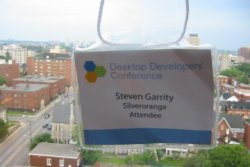
I was at the Desktop Developers’ Conference in Ottawa this week. The DDC was for developers working on Linux on the desktop and it started off a week in Ottawa that also includes the Linux Kernel Summit and the Ottawa Linux Symposium (neither of which I stuck around for – both being way over my head).
Here are some observations from the conference:
- T-Shirts and golf-shirts with project/company logos are the war-paint. Despite having a lot of these shirts myself, I resisted wearing any of them to the conference.
- Where the ladies at? (about 75 people and no women)
- Even though everyone has a cell phone and a laptop with IM on WiFi, there are almost no annoying phone/IM sound interruptions
- There is a constant, but not distracting, pitter-patter of laptop keyboards
- There was lots of debate and productive discussion – people were getting work done
- People seem to like Canada
- Lots of people knew of Prince Edward Island, and think of it as a idyllic vacation destination (true for a few months of the year)
- Traveling is much better when you have friends to drive your around, feed you, etc.
For those interested in the details and contents of the conference, here are some details other attendees have posted:
- Edd Dumbill gives an overview of the 2004 Desktop Developers’ Conference
- Chris Blizzard summarizes Havoc Pennington’s Keynote about the state of desktop development
- Chris Blizzard summarizes Dan Stone’s talk about the state X at freedesktop.org
- Chris Blizzard summarizes Thomas Fitzsimmons’s talk about the Java development for the desktop
- Friend and co-worker, Nathan Fredrickson, came along with me and will be at the Ottawa Linux Symposium for the rest of the week
I’m on my way to the airport to catch a flight back home in a few minutes.
Why I am the Future of Radio
First of all, I should be clear. When I say “radio”, I mean music and speech, not necessarily broadcast via radio waves.
Since November of last year I have been occasionally putting together short (30-50 minute) radio shows comprised of music I want to share along with my nerdy voice telling the listening world why they should love this music (or at least why I love it).
From the point of view of traditional radio, there are some serious problems with my humble show:
- There is no mechanism for artist compensation
- I ramble and stumble over my words
- I am generally a fool
The first problem isn’t up to me to fix (beyond throwing some cash at the EFF to try to affect change in our copyright system). The second and third problems are beyond my ability to fix (I think).
What’s important, though, is that these two problems are from the point of view of traditional radio. You and I are not traditional radio.
To a small group of people, my rambling/stuttering-foolery is bearable – maybe even sometimes enjoyable. These are my friends and a few kindred passers-by.
My Taste and Rambling Do Not Scale
The music I chose, and even more so, the commentary I record, has limited appeal. It is unlikely that it would ever be downloaded regularly by more than a few hundred people, if that. However, that doesn’t matter.
The cost for me to record and distribute my show is negligible. The joy I get from choosing the music and sharing my thoughts is by far sufficient motivation to produce the show. The feedback get from the small group that do listen regularly makes it all the more rewarding.
The hardware and software to put together a show like I have are already in the hands of many, if not most, people on the web.
I am Not Alone
Fortunately, it’s not me alone that will comprise the future of radio. That is the key. There are others.
So far, I’ve been listening to these web radio shows:
- Adam Brault’s MathCaddy Radio – It takes a format similar to Acts of Volition Radio – music picks and commentary
- LUG Radio – Really geeky talk radio show by a bunch of Linux geeks from the UK. Laced with profanity and surprisingly funny
- ITConversations.com – Not quite a radio show in of itself, but a collection of audio interviews and conference presentations by information technology leaders. Highlights include Tim O’Reilly on the shift to web-as-application-platform and a recent episode of The Gillmore Gang with Brendan Eich from the Mozilla Foundation
Some of these might sound like audio punishment to you, but that is part of the beauty of downloadable internet radio: you will never hear these unless you want to. You will never stumble across one of these shows when you are flipping through stations in your car.
While I’m listing to music geeks and geek geeks, you can find (or produce) radio on the subjects that you are passionate about.
Small shows produced by enthusiasts with small audiences don’t show up in Billboard charts or Nielsen ratings, but they can be a far more rewarding experience for the listener and producer than traditional broadcast radio.
I spoke and wrote a bit about this subject back in 2002. Re-reading my post I think the points about audio making sense for some applications and text for others still holds up. Music, of course, is one of the greatest applications of audio.
I think I’m a “Regressive”
Having lived through a federal election here in Canada last month, and witnessing much of the partisan debate leading up to the presidential election in the US, I hereby declare that the word progressive is devoid of meaning.
If you do insist on using the word, please keep in mind that it is an adjective – not a noun. Pretending, for a moment, that the word had meaning, you cannot “be a progressive”.
Also see: words and phrases due for retirement.