Download a hilarious sci-fi spoof TV series pilot with Ben Stiller, Jack Black, and Owen Wilson
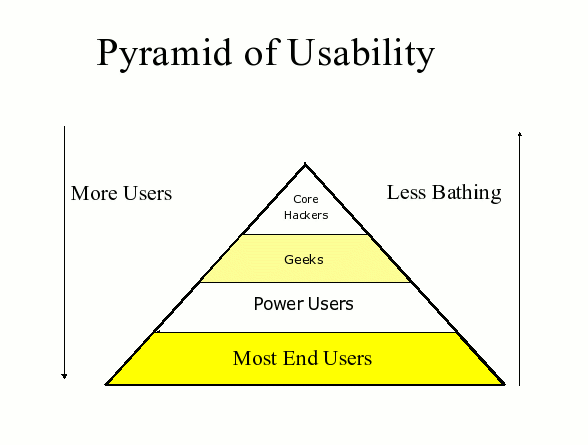
Usability is inversely related to bathing – a great slide from Nat Friedman’s talk from the Gnome Conference in Norway
Phantom Cell Phone Vibrations
Definition: The phenomenon of experiencing a sensation of vibration in the pocket-region, leading one to believe their cell phone is vibrating. The sensation can be triggered by other vibrations, such as the engine in a car, but can also appear when no external stimuli is present.
Also see: Phantom Phone Ringing
Don’t come asking me for technical support, but I’ve got Photoshop running nicely on Linux with CrossOver Office
“Common Sense is temporarily offline.”
Yes, the browser wars are back
I’ve been referred to as Steven “Acts of Volition” Garrity – I like it!
Donate to the National Multiple Sclerosis Society and win a GMail account
Acts of Volition Radio: Session Eleven
 This session of Acts of Volition Radio is a loose collection of story-songs and miscellany. It is punctuated by my reporting on the amusing musical selection of my sun-bathing and boom-box weilding neighbours.
Story songs and miscellany. Recorded Sunday, June 27, 2004 by Steven Garrity. Run time: 35min.
Session Eleven Playlist:
- Stephen Malkmus – The Hook
- Crash Test Dummies – The Superman Song
- Crash Test Dummies – The Ballad of Peter Pumpkinhead
- Pedro The Lion – Bands With Managers
- Sloan – Underwhealmed
- Bad Religion – Stranger Than Fiction
- MxPx – Play It Loud
For more, see the previous Acts of Volition Radio sessions.



/
RSS Feed
More on the Web as Application Platform
A collection of articles surfacing on weblogs coalesced for me this morning. John Gruber’s article, The Location Field Is the New Command Line, is about the rise of the web as a viable application platform. The article builds on Joel Spolsky’s How Microsoft Lost the API War.
Gruber talks about how the web is successful as an application platform despite is weaknesses. This reminded me of Cory Doctorow’s heavily linked (and deservedly so) talk about the ills of digital “rights” management.
Doctorow discusses how media are successful not because they are better at what the old media was good at, but because they are better in some new and different way:
“New media don’t succeed because they’re like the old media, only better: they succeed because they’re worse than the old media at the stuff the old media is good at, and better at the stuff the old media are bad at.”
He goes on to give some examples:
This is the overweening characteristic of every single successful new medium: it is true to itself. The Luther Bible didn’t succeed on the axes that made a hand-copied monk Bible valuable: they were ugly, they weren’t in Church Latin, they weren’t read aloud by someone who could interpret it for his lay audience, they didn’t represent years of devoted-with-a-capital-D labor by someone who had given his life over to God. The thing that made the Luther Bible a success was its scalability: it was more popular because it was more proliferate: all success factors for a new medium pale beside its profligacy. The most successful organisms on earth are those that reproduce the most: bugs and bacteria, nematodes and virii. Reproduction is the best of all survival strategies.
Piano rolls didn’t sound as good as the music of a skilled pianist: but they *scaled better*. Radio lacked the social elements of live performance, but more people could build a crystal set and get it aimed correctly than could pack into even the largest Vaudeville house. MP3s don’t come with liner notes, they aren’t sold to you by a hipper-than-thou record store clerk who can help you make your choice, bad rips and truncated files abound: I once downloaded a twelve-second copy of “Hey Jude” from the original Napster. Yet MP3 is outcompeting the CD. I don’t know what to do with CDs anymore: I get them, and they’re like the especially garment bag they give you at the fancy suit shop: it’s nice and you feel like a goof for throwing it out, but Christ, how many of these things can you usefully own? I can put ten thousand songs on my laptop, but a comparable pile of discs, with liner notes and so forth — that’s a liability: it’s a piece of my monthly storage-locker costs.
Here are the two most important things to know about computers and the Internet:
- A computer is a machine for rearranging bits
- The Internet is a machine for moving bits from one place to another very cheaply and quickly
Any new medium that takes hold on the Internet and with computers will embrace these two facts, not regret them. A newspaper press is a machine for spitting out cheap and smeary newsprint at speed: if you try to make it output fine art lithos, you’ll get junk. If you try to make it output newspapers, you’ll get the basis for a free society.
And so it is with the Internet. At the heyday of Napster, record execs used to show up at conferences and tell everyone that Napster was doomed because no one wanted lossily compressed MP3s with no liner notes and truncated files and misspelled metadata.
Today we hear ebook publishers tell each other and anyone who’ll listen that the barrier to ebooks is screen resolution. It’s bollocks, and so is the whole sermonette about how nice a book looks on your bookcase and how nice it smells and how easy it is to slip into the tub. These are obvious and untrue things, like the idea that radio will catch on once they figure out how to sell you hotdogs during the intermission, or that movies will really hit their stride when we can figure out how to bring the actors out for an encore when the film’s run out. Or that what the Protestant Reformation really needs is Luther Bibles with facsimile illumination in the margin and a rent-a-priest to read aloud from your personal Word of God.
So it is with web applications. They don’t succeed because they are better at the things traditional were good at (rich UI, etc.). In some ways, there are much worse than traditional applications. Like MP3 vs. CDs, web applications are better in new and different ways.
Ian Bicking has more in what makes web applications good.