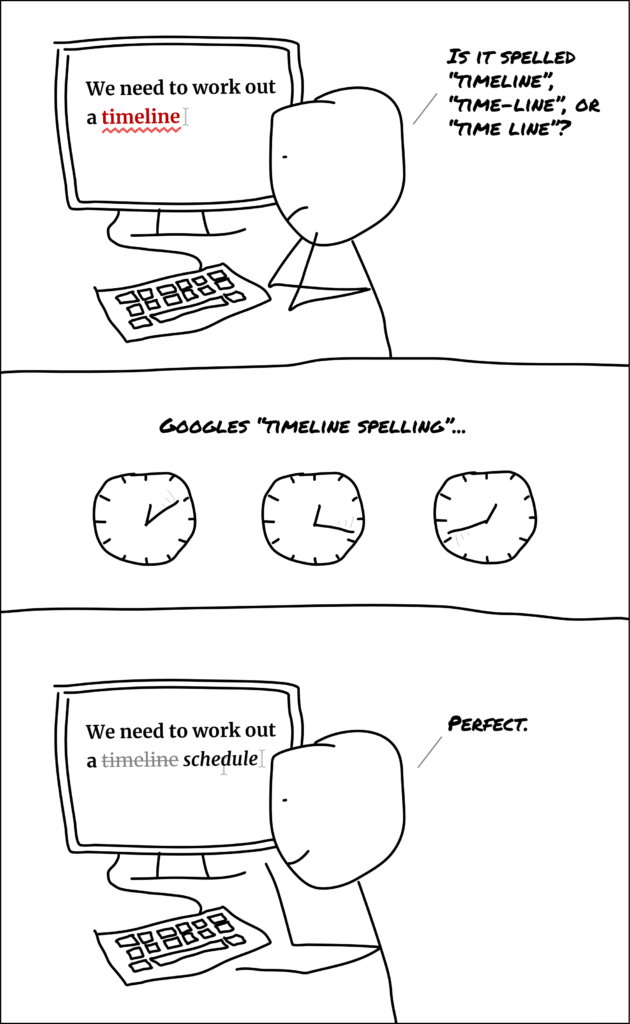
Spelling timeline
My dream car is:
My dream car is not:
($CURRENT_YEAR + 10) when I don’t need a steering wheel.As of today, the closest thing to an electric minivan is a $100,000+ Tesla Model X super-car SUV with embarrassing super-doors. Chrysler does sell a plug-in hybrid Pacifica minivan that could work for us. I’m curious to learn how practical it is to drive in all-electric mode by default and fall back to internal-combustion only when you’re out of battery.
Given that my requirements are not likely to be met any time soon, I’ll likely need to consider alternatives. We may have to settle for a smaller vehicle and pay more for something newer than we want/need. We may also need to consider giving up on our dream of owning only one vehicle. We could go for an older, cheaper gas-powered minivan for occasional use, plus a smaller electric vehicle for regular/daily use.
It’s unfortunate that going electric is still a luxury. I look forward to the time when the cheapest Kia, Hyundai, Honda, & Toyota are all-electric.
All of this said, I could just step up an buy a used first-gen electric Kia Soul for $15,000 or so. It’s been done.
If you had shown me some of the basic features of today’s design tools like Figma and Sketch back when I was using Photoshop ten (and twenty) years ago, my head would have exploded:
This Netflix stand-up comedy special by Tom Papa, You’re Doing Great, is worth a watch. I suspect your enjoyment of it may wane the further you get from the tired-dad demographic, but that’s me.
This highlight on the “Good Old Days” is a good teaser (mildly not safe for playing out loud at work):

Though I don’t know the details, the Canadian government seems to require internet service providers to allow other vendors to resell access on their networks. For example, here on Prince Edward Island, Bell and Eastlink have the infrastructure to get internet access to homes in the form of actual cable and fiber-optic lines. There are other ISPs that sell home internet access, but under the surface, they’re just relabelling service on Bell or Eastlink networks.
I had been using Eastlink for home internet, mostly for historical reasons. As of January 2021, Eastlink’s least expensive home internet plan is $100.95/month before tax (100Mbps down, ~10mbps up).
City Wide Communications resells this same level of service (on the same infrastructure) for $54.95/month. A savings of $46/month
It is worth noting that Eastlink offers this $100.95/month service at a rate of $79.95/month for the first 12 months. I try to ignore any kind of “introductory offers”, as I end up with services like this for many years. Also, the City Wide service is still $25/month less than this introductory rate.
I was a bit skeptical of switching, as the inconvenience of any administrative overhead or the headache of switching just isn’t worth it for me. That said, saving over $500/year was enough for me to try it out.
It has been four months since I switched from Eastlink to City Wide. I’m happy to report that the switch was easy, and the level of service has remained the same.
On another note, I also switched our ‘landline’ home phone from Eastlink to City Wide. This was also much cheaper, but with the caveat that with Eastlink, it’s an actual wired home phone setup, while City Wide offers a voice-over-IP service over the internet. In theory, they should work identically, but the ye-olde phone network feels more stable to me.
I did run into issues with my VOIP service on City Wide were a few times when the VOIP home phone box would disconnect and fail silently. We wouldn’t notice until we tried to make a call, and then we’d realize no one could call us for who-knows-how-long. This happened on-and-off for a few weeks, but just before I got annoyed enough to contact their customer service, the issue went away and has been stable for several months now.
I hope more people learn about these resellers, if only to drive down the rates of the established providers. I’d be happy to be a customer of Eastlink or Bell, but I’m not going to pay double for it.
I’ve been working at the Web design and development agency, silverorange, since we founded it in 1999. It really is a great place to work.
Though we are distributed across Canada, we work together on PEI for a week each summer, and get away from our regular work to retreat together for a week each winter (except during pandemics, when we go all remote).
Back in 2016, I wrote about how silverorange is one of the things I’m most proud to have helped create.
There are 21 of us working at silverorange these days, and we’re looking to hire for three additional positions:
If any of these roles are of interest to you, I encourage you to apply. If there’s someone you know you who think would be a good fit, poke them about it too. Thanks.
When writing in the cleverly-named Markdown markup language, I could never remember which comes first in the syntax for a link, square or round brackets.
This is an [example](https://example.com/).After discussing this with a colleague (who I’m assuming doesn’t wish to be acknowledged here), we settled on an alliterative mnemonic that has helped me for years.
Round brackets look more like a bum, and the round brackets go at the end. So remember: When it comes to links in Markdown, bums go in the back.

This is a screenshot from a High Interest savings account. Ask me about my personal investing strategy!

I’m always interested to learn how others use their computers. In that spirit, here’s a list of the services that I find valuable enough to pay for online. I think of it as a few dollars here and there, but with exchange rates it adds up to around $70/month Canadian.
While not a regular contribution, I have donated a few dollars to the Slashfilmcast film/tv podcast on occasion as I’m often delighted by their podcast.
I had paid for Amazon Prime for a while, but decided I didn’t need to pay to make it easier to buy things online. Breaking news: I’m back on a free one-month trial around pre-Christmas shopping. I don’t plan to continue it beyond that.
There are also a few services that I get through my work at silverorange. Some of these I might pay for myself if they weren’t covered by my company: