If you’ve watched the remarkable Chernobyl series on HBO and played the Half-Life series of video games, then please enjoy this: Chernobyl dubbed with Half-Life SFX. If one or the other of these is not familiar to you, then you get the next 2 minutes of your life back.
Author: Steven Garrity
The 20th anniversary silverorange art project
One of the many interesting and rewarding parts of my job this year was to curate and participate in the 20th anniversary silverorange art project. It’s an art project that celebrates the 20th anniversary of silverorange (naming things is hard).

Thanks so much to everyone who participated.
I really do love all of the entries, but I’m particularly delighted that our friends Tom Hughes, Sean Martell, and Geoff Gibson were able to participate.
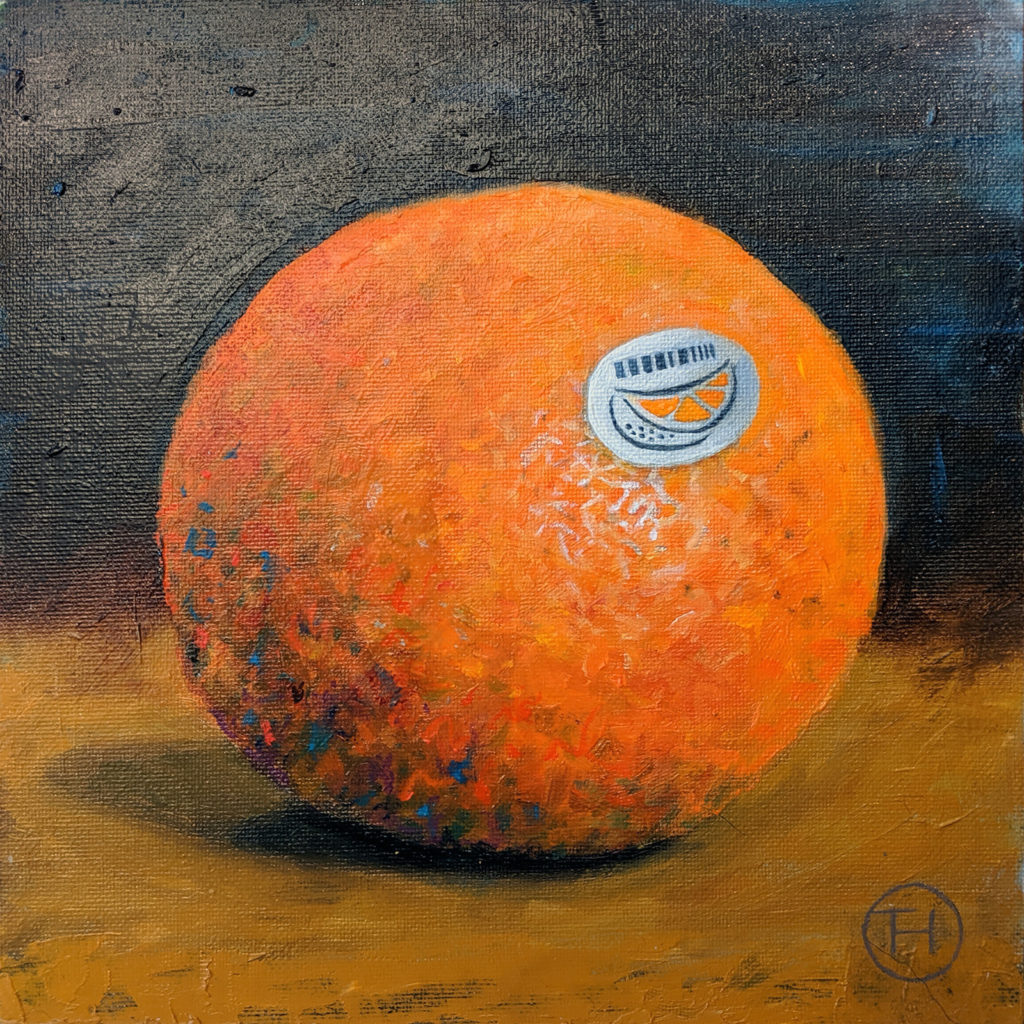
Tom did an oil painting:
Sean created a hybrid Firefox / silverorange:

Geoff created an illustrated collage of references his time with silverorange:

My closest office-neighbour, Stephen DesRoches, even painted an actual orange slice!

The woods of Naufrage
My life was enriched in my ways when I got married 14 years ago. One of these ways is the deep connection my parents-in-law have to the “North side” on the Eastern end of Prince Edward Island. This includes a humble cottage in an extraordinary location near the Shipwreck Point Lightstation in Naufrage, PEI (Naufrage is French for ‘shipwreck’).
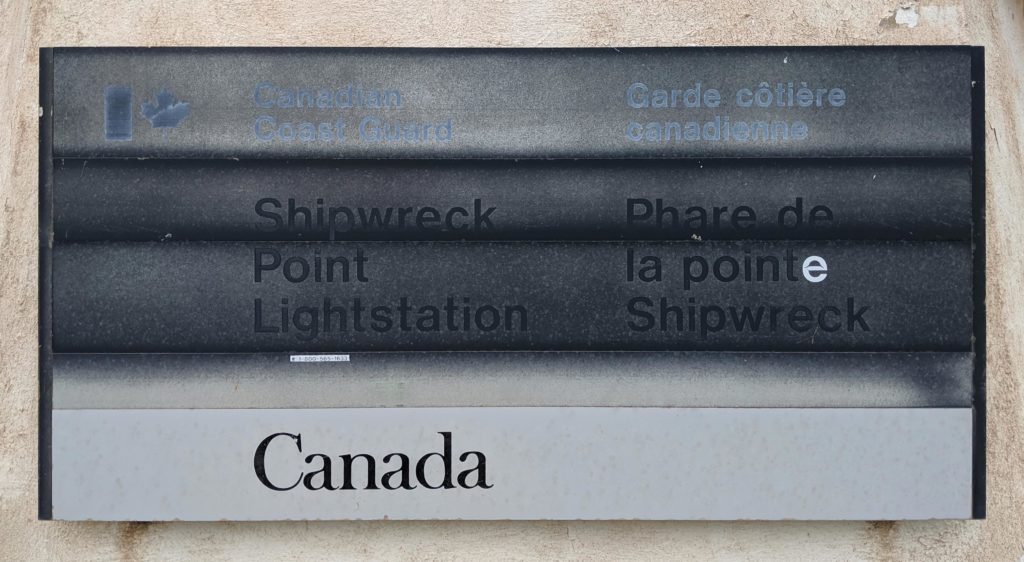
Like many cottages, this one is a patchwork of additions and repairs that have accumulated over decades. It is furnished with items that outlived their usefulness or fell out of fashion at their primary home and retired to the cottage life.
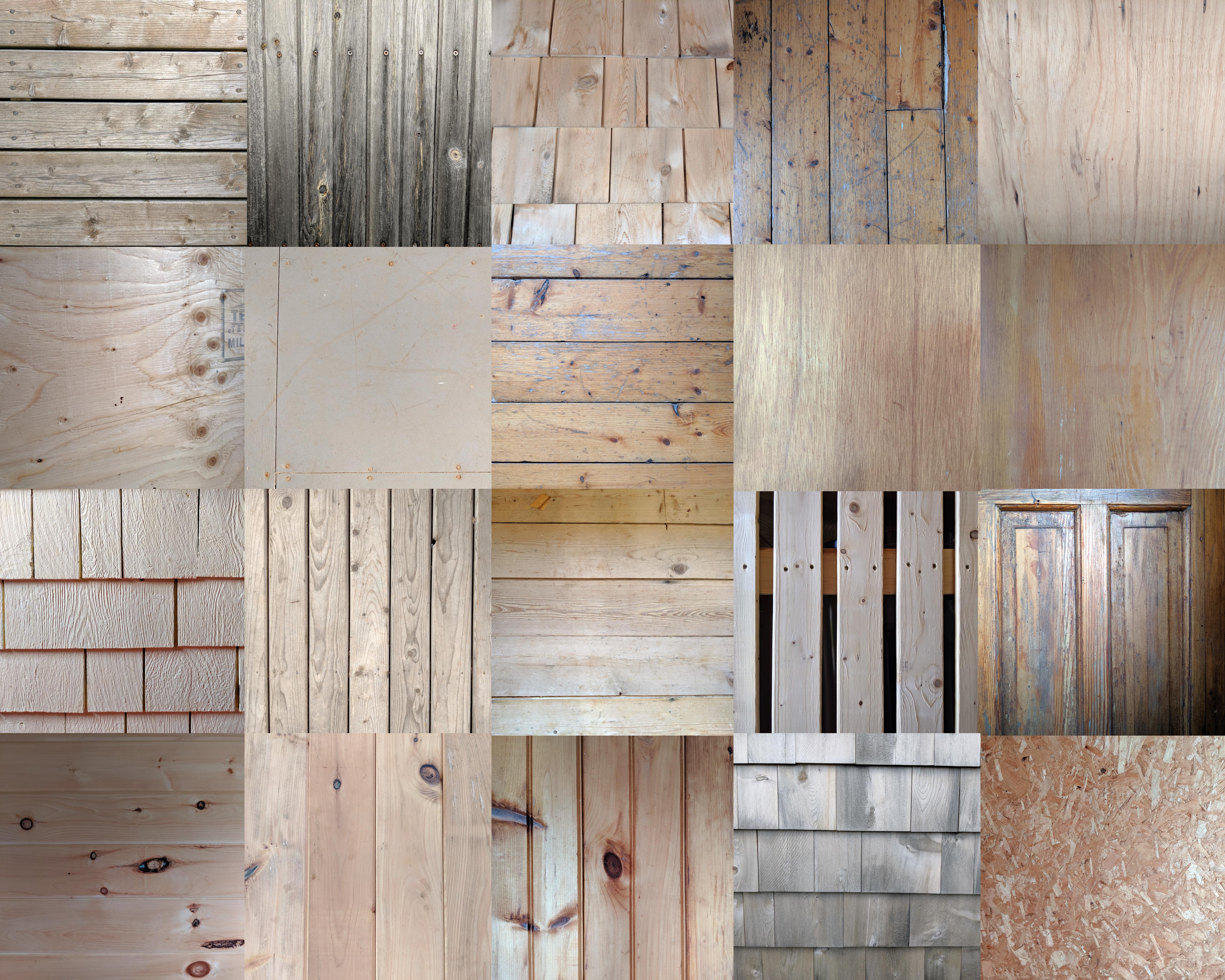
On our most recent stay, I was struck by how many different types of wood grain, panelling, and shingles there are in the cottage. I counted at least fifteen:
Digital yak shaving
While at work today, I set about a relatively simple task: Write a summary of a new job opening we have to share on Twitter.
What followed was a yak-shaving rabbit hole mixed metaphor of multitasking. Here’s how it went:
- Ok, I want to write a tweet about the new job posting
- I need something to count characters while I write the draft
- Open VS Code, but notice line-wrapping is off – don’t want to change that setting
- Go to open Sublime Text – notice I don’t have it installed on my new laptop
- Download Sublime Text
- Notice it’s not registered, but I think I have a paid registration
- Look in 1Password for Sublime Text registration
- Get a Slack reminder about a whole other thing – do that other thing
- Look in Mail for Sublime Text registration
- Forget why I opened mail and start reading unrelated email
- Realize how far down the rabbit hole I am and start writing this list
- Find the Sublime Text registration email and re-register Sublime Text
- Actually write that tweet
Some of the disjointed nature of this process a reasonable by-product of working in and with digital tools. Some of it is just my own weakness in maintaining focus.
Oh, I did eventually get that job post shared – it’s a great job for a front-end web developer:
On merit
In the technology industry and others, I’m sure, it is often cited that those in under-represented groups should not be given additional consideration because hiring should be based solely on merit. This sounds reasonable and fair, though I’ve grown to feel it is neither.
The following quote from actor and activist Geena Davis on the WTF podcast articulates the danger of a narrow consideration of “merit” in a more effective way than I’ve heard before:
“…I don’t think anyone can say ‘I hire based on merit’ if they haven’t taken conscious proactive steps to overcome their unconscious bias.”
Gina Davis on WTF with Marc Maron
The whole interview is worthwhile, as is Davis’ work with the Geena Davis Institute on Gender in Media.
Unbreakable promise
I was talking to a friend recently about the perils of helping young kids manage uncertainty when they see disconcerting changes. My instinct is to say “Your mom & dad will always be together”, or even just “I’ll always be here for you.”
While I fully intent to fulfill both of those promises, they are dangerous promises to make as they can depend on forces outside of your control.
My wise friend shared the promise he makes to his son among uncertainly—a reminder of a reassurance that he really can promise: “I will always be your father.”
Martha
My friend at silverorange has written a beautiful tribute to his mother and her contribution to his life and our company.
Martha was kind and generous to all of us in the early years of silverorange.
About 18 or 19 years ago, she had an 1978 Volvo station-wagon sitting around that she let me borrow one winter. The only catch was, I didn’t know how to drive a manual transmission.
Martha didn’t seem to think this was much of an issue. She’d just teach me how to drive it when she dropped it off for me. There in the UPEI parking lot, my friend’s mother showed me how to drive a manual transmission so I could borrow their extra old car for six months.
She was a special person. See Nick’s full tribute: A Mother’s Mentorship.
Group sizing bug in Sketch app on macOS
Update: I submitted this to the Sketch team as a bug report. They’ve responded that it should be fixed in the next version and is already fixed in the current Beta.
Update #2 (May 31, 2019): This issue is now fixed in Sketch (v55.1). Thanks!
I’ve noticed a bug in Sketch and I’ve documented it here in a quick screen-cast in hopes that it will get fixed and that others can understand and work around it.
To trigger the bug:
- Create two objects in a Sketch document
- Group those two objects
- Select one of those objects and move it with the keyboard in such a way that the group is now larger (for example, move the rightmost object further to the right)
- Click anywhere on the canvas to clear the selection and apply the keyboard move
- Select the group and notice that the width of the group is that from before the move – double-clicking on the portion of the moved object that is outside of the group has no effect
Now, to get Sketch to properly reflect the new larger size of the group, select one of the objects in the group and hit Escape. This seems to trigger Sketch to update the size of the group.
It sounds complicated when written out like that, but I’ve narrated a quick screen-cast to illustrate the issue:
Cleverness expires almost immediately
I write a short post about how we chose the name “silverorange” for our company. We skirted catastrophe.
Everything old is neue again
The best part about Monotype’s updated Helvetica Now font family is that we can stop pretending to know how to say “neue.”