the 5k audi tt vr gallery

The5k is a web competition in which the entries must be less than 5 kilobytes (5,120 bytes) in total file size. To put that in perspective, the front page of actsofvolition.com today is 28 kilobytes of text/HTML and over 41 kilobytes of images. From the5k.org:

PURPOSE
The idea behind the contest is that the rigid constraints of designing for the web are what force us to get truly creative. Between servers and bandwidth, clients and users, HTML and the DOM, browsers and platforms, our conscience and our ego, we’re left in a very small space to find highly optimal solutions. Since the space we have to explore is so small, we have to look harder, get more creative; and that’s what makes it all interesting. Just celebrating that is all.

Some of last years entries were truly amazing including a store with a working shopping cart, a working 3D Tetris game, a drawing program with save funtion, and a web-safe color chart complete with preview, each less than 5 kilobytes.

I made a humble entry last year which was cruelly and viciously mocked (particularly bothersome since the criticisms were witty and somewhat justified).

the 5k audi tt vr galleryMy goal this year was to create an entry that would not solicit public ridicule. Together with Nick and Nathan from silverorange, we have created the 5k audi tt vr gallery. Due to obvious file size constraints it only has three frames of rotation. If we had more time, I’m sure we could have squeezed in eight frames and made it more netscape-friendly. However, we only started the day before the deadline (a technique I picked up in my days as an academic).


put a post it note on the empire state building

In anticipation of ubiquitous wireless palm devices and GPS, GeoNotes is a system with which you can annotate physical locations and read the annotations of others with your palm device.

For example, if you visit a restaurant and find the pasta to be particularly good, you can sumbit your gastronomical musing to the system. All future customers will have the benefit of your experience when they arrive. Very cool. Found via peterme.com.


waking up is hard to do

The summer I graduated from high school, I quit my job at a grocery store (something I had promised myself a year earlier I would do after a year at the job) and took a job with the government. Come to think of it, I don’t even know who I was working for, HRDC or Industry Canada maybe. Regardless, the job was to build websites for non-profit organizations. It was a make-work project through and through that seems vaguely communist in retrospect. I got the job through a referral and recommendation of my high school computer teacher (one of the best teachers I had).

This is not to say, however, that I was at all qualified. Nobody was at the time. The web was young and frames where bleeding edge technology. I got a great start at that job. It was slack, fun, and I earned a humorous nickname from my co-workers. What I remember most about that summer, though, is waking up. And I don’t mean some kind of epiphany or religious awakening, I mean waking up every morning.

I started work somewhere around 8:30 or 9:00 in the morning. The job was about a fifteen minute bike ride from my house (a very similar route to the one I had taken on a bus to high school everyday for the three preceding years). I would wake up in the morning at around 7:00 or 7:30 because I was ready to, with no aid from an alarm clock. I would shower, eat breakfast (remember breakfast?), and bike to work.

I remember it being sunny every day. Some days I would wear my walkman and listen to Stranger than Fiction by Bad Religion (out of character for myself at the time). Other days, I would travel without a soundtrack.

I packed a lunch everyday, which I would eat outside with my co-workers (a fantastically odd lot). Since I was making good money and still living at home, I had money to burn. With nothing else to spend my money on other than a Fender HotRod DeVille 410 60 watt tube guitar amp I had been dreaming about (and have since bought), I spent most of my salary on compact discs. The mall was between work and my house and I used to stop by the music store once or twice a week. I remember one day in particular where I bough superunknown by Soundgarden and there where actually two CDs stuck together in the one case. I was like winning the lottery.

It was a good summer I spent there. I had a good job. I worked with interesting people. But what really separates that summer from every other, both before and since, is the mornings. I would wake up every morning feeling rested and looking forward to going to work.

At this point, perhaps a bit of context may help explain why this is so important to me. The first 20 minutes of the every day of my high school career where hellish. I woke up to an alarm feeling like I had fallen asleep only an hour ago. I used to claim illness on days where I just couldn’t bring myself to get out of bed.

Since that summer I’ve had better jobs (and no job at all) but I have never had another time in my life where it was so easy to get out of bed in the morning. Even now, when I have a rewarding and challenging job (often more challenging than it is rewarding, mind you), I still have to fight my way out of bed every morning. No matter how great the hours that follow promise to be, the first 15 minutes of every day are perpetually difficult.

Clearly, there are some factors at play here that are in under my control. Diet, exercise, and going to bed at a reasonable hour would all help, I’m sure. But what I remember so fondly about that summer of pleasant mornings was that it was effortless. The dread of impending morning didn’t drive me to bed every night. I went to bed when I was tired, ate when I was hungry, and woke up in time for work every morning.

I was conscious of it at the time. I knew I had a good thing going on. I can still remember waking up and thinking, “Wow, I don’t mind getting out of bed. This is good”.

Since that summer, this state of waking up with ease has become for me something of a Holy Grail for me. Not so much that I would try to get more exercise, or eat better, which I’m sure would help. Rather, I’m just waiting for a point in my life when it will once again be effortless to get out of bed every morning.


good teachers remembered

This is a slightly “the more you know”-esque post. Teaching must be a difficult profession. Here a few of my better teachers:

Mr. GrantGrade 4 English
Mr. Grant gave me and a few of my classmates a special assignment to read a book that was slightly above the grade 4 level (or so I thought). He seemed like an actual human being, as opposed to the other teachers which seemed like, well, teachers.
 
Mr. GriesbauerGrade 12 Computer
I remember being amazed at how the same few kids who would practically crucify the teacher in first period would then engage in a meaningful and pertinent debate with Mr. Griesbauer only a few minutes later. The difference between him and the other teachers was that there was a mutual respect. He encouraged me to pursue my current career path and even helped me get a job to get me started. I understand he’s since been swallowed up by an administrative position.
 
Ms. WillisGrade 12 Math
Since she was the principal we had all assumed she was a crazy and vindictive woman. As it turns out, she was very good at teaching math and took a genuine interest in each of her students. By the time I took her class she was only teaching the one course and spending the rest of her time with her duties as principal. I remember one day she asked us if we felt she didn’t have enough time to adequately teach the class since she was principal. It was risky to ask a meaningful question like that to a class of teenagers. She was leaving herself vulnerable. In an uncharacteristic display of maturity, we told her that not only was she doing a great job teaching, but that she should teach more. I think she’s full-time administration now.
 

the future of (non)interface design: it’s in the game

The fundamentals of the computer interface have remained basically unchanged since 1973 when Xeroc PARC came up with the mouse-based window interface concept. A quick look back at Apple in 1980 will show you how similar your current OS interface is to these supposed antiques.

This isn’t necessarily a bad thing. It is a good design, but there could be better. Jakob Nielsen is all about the next big thing, which is (according to him) the anti-mac interface. He and his cohort, Donald Norman have long touted the non-interface (and even the non-computer).

Black & White
Having grown up with window & mouse type computing, it’s hard to imagine anything beyond it (PalmOS is one of the few examples of an alternative). Recently, Lionhead Studios has taken an interesting step into what the future of interfaces may be. Their new game, Black & White has no menus or buttons, just a hand controlled by your mouse. Gamespot describes it well:

“You the player are manifested as an elegantly simple, all-powerful hand hovering above the earth. Not wanting to break the illusion of the gameworld with buttons, tabs, and menu screens, the designers have made the hand the entirety of your interface.”

It seems to be quite intuitive and should prove an interesting experiment in interface design. Of course, I don’t play computer games.

A few other interesting notes about the game: Apparently, Lionhead Studios planned to ship two versions of the game (one black and one white), one costing $5 more. The extra $5 was to be donated to a charity. This is a play on the theme of the game in which you are a god and have the choice to be benevolent or evil. The added complexity for retailers prevented the plan from going through, but they deserve credit for trying. Brilliant.

Also, the game uses your Outlook contact list to name is characters and apparently attempts to check weather reports online and match in-game weather with the weather from your region. These guys deserve every cent they make.

Again, a reminder: I don’t play computer games.

UPDATE:
More on the game Black & White in this behind the scenes development article at Gamespot.


this site is best viewed at 800 by 600 in the designer’s basement

“Liquid Layout”. I picked up the term a few years ago from a tutorial by Lance Arthur of Glassdog.com. Liquid layout describes a website with a variable width, depending on how big your browser window (and screen) is. For example, open CNN.com, close the annoying popup window that asks you what continent you are from (!?!), and then try stretching and squishing the size of your browser window. Notice how the content of the site stays the same width regardless of the browser width. Now try Search.com. Notice how the content stretches and squishes to fit your window without introducing a horizontal scroll bar.

Who cares? Very few people, apparently. I do. A good liquid layout ensures a good visual experience for users on a wide variety of screen sizes. It’s harder to do for the designer and involves some sacrifices and limitations, but some of the best design comes from within strict constraints.

Imagine a print designer who claimed that to truly see his masterpiece coffee table book at its best you had to look at it in natural light and with 20/20 eyesight.

“Colors look a little washed out and the type is small.”
“Fluorescents won’t do. I designed it to be seen in the light of nature. Maybe you need glasses.”
“Fuck you.”

Expecting someone to change their computer configuration (particularly screen size) is like expecting people to buy a new car to go to the drive-in. Rather than clinging desperately to control of each and every pixel with white knuckles, web designers should embrace the openness of the web.

For those web developers who struggle with browser incompatibilities and nested tables for the perfect liquid layout, I appreciate it (for what it’s worth). Below are a few examples of fine liquid layouts I’ve come across. If you know of a good liquid layout let me know (steven@actsofvolition.com).

  • Blogger.com – One of the best I’ve seen. Designed by Derek Powazek of Powazek.com (currently a k10k news contributor).
     
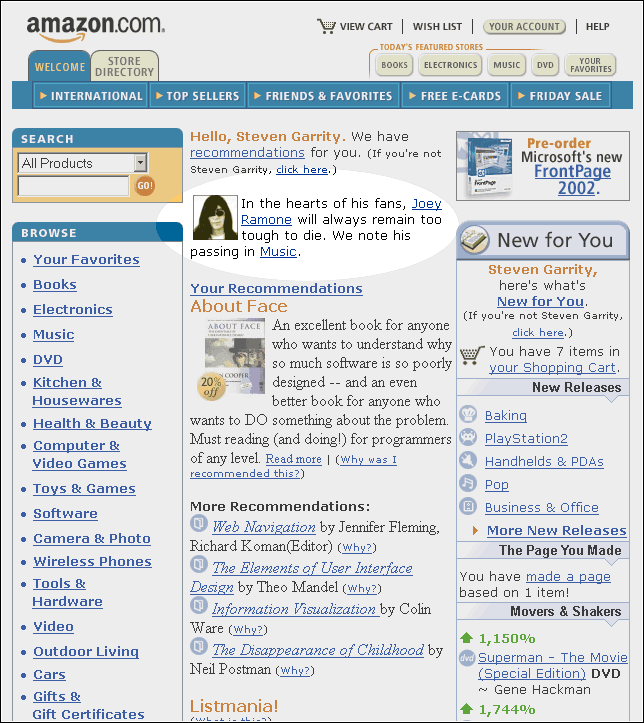
  • Amazon.com – Kings of the useable web. Their related products features are frighteningly effective. One of the few major sites that still works at a 640 by 480 resolution.
     
  • Search.com – One of Cnet’s few remaining liquid layouts (along with Cnet.com). R.I.P. Gamecenter.com and the formerly liquid News.com.
     
  • Sapient – Monster web shop. Creativity and originality on an assembly line (they must use macs). Nicely liquid pages, although they start quite wide (defeating the purpose somewhat).
     
  • Slashdot – Ugly but distinctive. Coders must think designing with white space is like writing inefficient code.
     
  • Send me more: steven@actsofvolition.com
 

weekend picks

A song, movie, and TV show you should enjoy:

song:
Westray by Weeping Tile (now of Sarah Harmer fame)
 
movie:
The Truman Show. Watch it again, for the first time.
 
show:
The episode of Northern Exposure where Chris Stevens, the host of KBHR builds a giant catapault to fling a live cow (it’s art).

If the media companies weren’t busy peeing their collective pants, I would have some way of linking you to these fine works. As it stands right now, you couldn’t even go find these gems even if you were willing to pay for them. Let’s wait and see if capitalism works it out.