Read Everybody must get stoned by Ian O’Doherty at Salon.com. It is short and you will laugh out loud.
Author: Steven Garrity
lessons learned in under 5k
 I’ve spouted on and on about this year’s 5k competition. There was last year’s embarrassing entry, this year’s long-shot, a surprising win, phony humility, and now, a bitter, bitter twist. Apparently our entry was in the wrong category and we have been bumped from the winners list (see the 5k news page).
As I mentioned before, my goal this year was not to be mocked. I think this is worse. Anyone have any advice on how I should tell my mom?
For the record, I hold no grudges. It was me who put our entry in the wrong category and we had a lot of fun working on our submission. The contest is great, and I was glad to see (and this will sound even more sincere now that I’m a loser) that the judges appear to have picked the winners based on creativity and originality rather than technical wizardry. And the current the5k.org front page is absolutely beautiful.
The lesson learned: Don’t bother. Stay in your basement (look forward to our properly categorized entry next year).
from the muddy banks of high school
High School was an odd time. The days I remember most are those spent driving my parent’s Saturn to the beach with a Poor Old Lu cassette. The times spent in class and in between have mostly fallen victim to traumatic memory loss – the trauma being boredom and social awkwardness.
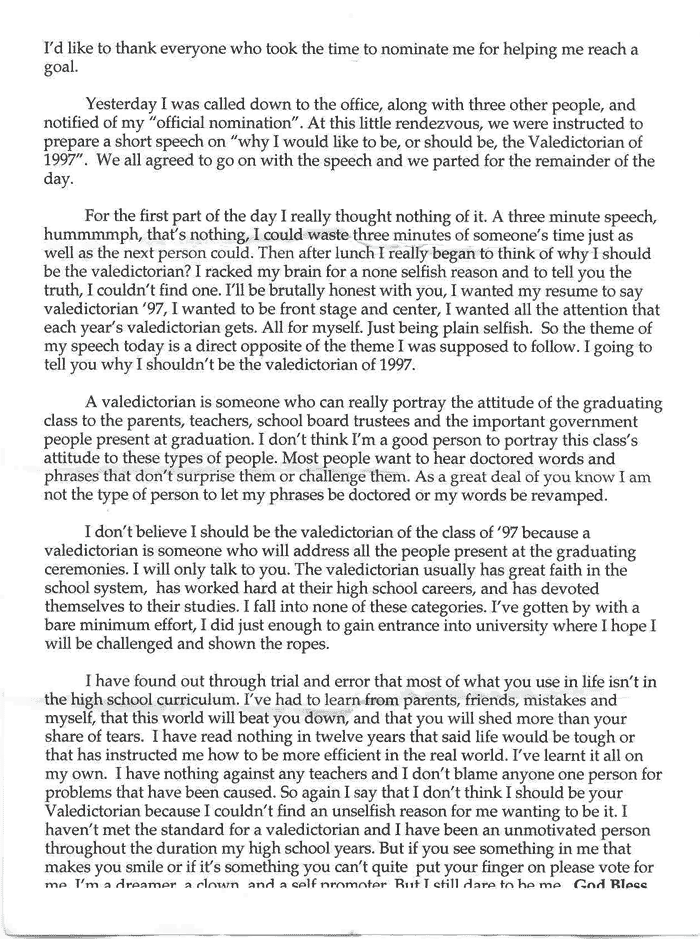 Enjoy this high school memory: The valedictorian nomination speech of Dan James, former high school delinquent / honours student, current top 50 CEO. After two other cookie-cutter valedictory nomination addresses, Dan took the stage in the cafeteria, removed the mike from the podium, and gave this, his valedectorian nomination address. He lost by a suspicious two votes.
farwell to douglas adams
My favourite part of the Hitchhiker’s Guide to the Galaxy series was the frictionless spaceship. You could touch it, but not feel it.
Douglas Adams died this week at age 49. I wonder how long it will take Amazon.com to start peddling merchandise related to the deceased.
In addition to being an award winning web designer, I am also a humble, humble man.

After a humbling (read: humiliating) experience in last year’s 5k competition, I enlisted the help of my good friends Nick & Nathan from silverorange with a simple goal: To create an entry that would not be mocked openly (like last year).
Once this year’s entries went up on the5k.org, I was amazed. Our entry couldn’t compare to some of this year’s amazing submissions (two of my favourites where the 5k Chess, and the 3D Dolphin). While our entry was put to shame by the other entries, it was not openly mocked. The goal was met.
Then in a bizarre turn of events the5k.org published this year’s winners and our humble 5k audi tt vr gallery was among them. First shock, then disbelief, then joy, then a king size (fr: GRAND FORMAT) 85g Oh Henry! bar to celebrate. In the HTML Only category we were #2 for Function, and #3 Overall.
How our entry was more functional than a working 5k chess game I’ll never know. That said, it is nice to see the judges steer clear of turning it into a javascript-writing competition. The other winners are not the most technically impressive, but are all definitely very cool.
genius recognized
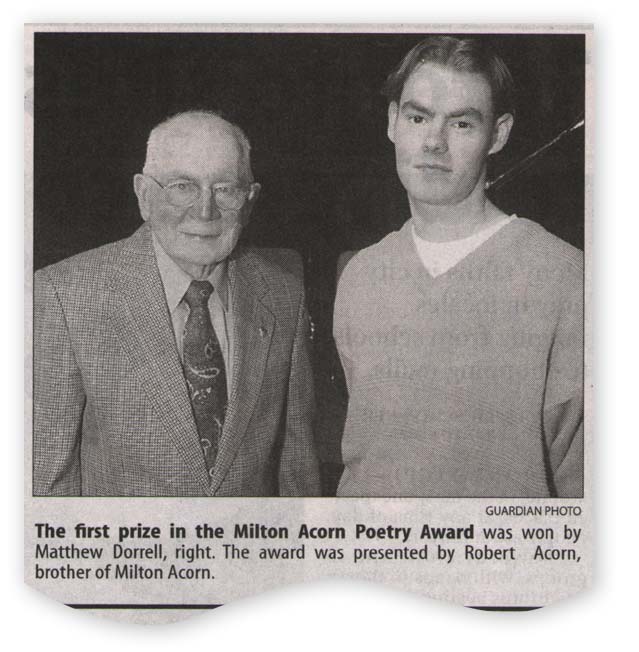
Our own Matt brings home the Milton Acorn Poetry award. Congratulations.
If you are not sure whether or not you should be congratulating him, you can read one of his poems at ForgetMagazine.com and decide for yourself.
forget the Quebec protests
 There are a few fine articles on the FTAA protests in Quebec at ForgetMagazine this week.
I’ve avoided commenting on the protests on aov so far, since the topic is so amorphous (globalization, free-trade, corporate rule, human rights, media, ect.). It’s hard to have a discussion when there are no parameters. However, this isn’t to say that there can’t be meaningful discussion.
I watched CounterSpin on CBC (a fantastic show) the weekend of the protests and felt at the end of the hour that a lot of smart people had made a lot of appeals to emotion. I was left more confused than I was at the start.
“The great enemy of clear language is insincerity.”
George Orwell is cool. 1984 and Animal Farm are staples of the high-school English class. If you read them in high-school, reread them. If not, read them. I was directed to an article Orwell wrote which feels like a hopeful obituary for the English language.
If you do any writing, professionally or personally, you must read Politics and the English Language. I wonder how his comments pertain to web-log writing where there is little editing and the tone tends towards speech. However, anyone writing in any medium should benefit from these ideas.
A few highlights from George Orwell’s Politics and the English Language:
“If you simplify your English, […] when you make a stupid remark its stupidity will be obvious, even to yourself.”
“Words like phenomenon, element, individual (as noun), objective, categorical, effective, virtual, basic, primary, promote, constitute, exhibit, exploit, utilize, eliminate, liquidate, are used to dress up simple statements and give an air of scientific impartiality to biased judgments.”
“The great enemy of clear language is insincerity. When there is a gap between one’s real and one’s declared aims, one turns as it were instinctively to long words and exhausted idioms, like a cuttlefish squirting out ink.”
“What is above all needed is to let the meaning choose the word, and not the other way about.”
selective news sympathy
I’ve commented before on how the news is mostly distant and without context. One Dead, Three Hurt in California Shooting. Shooting in N.S. town leads police on high-speed chase of suspect. Blah, blah, blah. When something hits closer to home, it will knock me on my ass, but I am unable to mourn the deaths of strangers when all I see is a 15 second video clip.
That said, I can remember a few isolated cases where the TV news really shook me. Vegging on the couch one afternoon, flicking randomly through the channels, an odd pattern formed. Every station started to show the same video feed. For the next half hour I watched, live, as armed FBI agents ushered students from a school in which two gunmen were still stalking. I couldn’t tune it out. It was sickening. I had to turn it off. The strange feeling I had that day, that I was seen something I shouldn’t, has stayed with me.
More recently, four junior-high-school kids were killed in a bus accident in New Brunswick. I sympathized with the survivors. Even now, I am uncomfortable thinking of the horror these kids must be going through.
There’s nothing unusual about being upset my school shootings and tragic accidents, but these two cases are some of the only ones I can ever remember having any impact on me at all. Most news to me is noise. A fire kills a family in Boston, a plane crash kills a celebrity. I could care less. I’ve got plenty to worry about with the people I actually know.
My point? Not sure. Just wondering aloud about selective news sympathy. Why is it that I can watch most news without blinking, however horrifying, while a select few stories keep me up at night?
planes, terrorists, and sad, sad songs.
A random collection of interesting things:
- Nasa scientists are going to attempt to fly an 11-pound model airplane across the Atlantic using the Global Positioning System (via Slashdot).
- If you are like me, you know very little about Canada’s 1970 ‘October Crisis‘ and you’ll benefit from the CBC’s look into the time the Canadian Government called on the War Measures Act.
- It’s been out for a while now, but a recent listen to The Unauthorized Biography Of Reinhold Messner by Ben Folds Five (who are apparently no longer together) blew me away. I sat down with the record as a moderate Ben Folds Fan having heard only the single and listen from start to finish. I listened to every word (not common for a first time listen). It is a sad and powerful album.