New Sloan best-of CD/DVD coming out with lots of video and two new tracks
Milton Glaser agrees that “creative” is not a noun
The Internet Revolution has Little to do with Technology
A minor epiphany this weekend, courtesy of my friend Peter Rukavina and a post on his weblog about cowboys. Peter writes:
It’s how the web changes how we think about the world that interests me.
I think that some of the ways the Internet is organized (decentralized, ubiquitous, anarchic, open source) and some of the the ways weblogs are constructed (interconnected, distributed, personal, opinionated) have inspired me (and others, including Rob, I think) to realize that we can do other things ” things that perhaps we’ve always done in a top-down, centralized, expensive, carefully controlled, closed source way ” differently.
For example, the Zap Your PRAM conference. This conference had no outside funding, no advertising, required no meetings to organize. And yet we had people from three countries gather in one place, almost spontaneously, for an interesting weekend of discussion.
Exactly! I wonder where I would be had I not found the world of technology and the web. Part of me pictures a utopia where I read more and spend all of my time with family and friends. The reality would probably involve watching a lot more television.
I’m not suggesting that the web saved me from a life of mediocrity. However, when you look at some of the fundamental ideas behind the web, a system where the power lies at the ends and there is no real centralization, it is easy to see how this could affect your general mindset.
Imagine a child who grows up in an environment where television is the primary medium. They are unlikely to ever be involved in the production of any television, or even to have a venue to provide input into what is broadcast beyond their commercial buying habits. Those involved with the production of television are distant and inaccessible celebrities.
Contrast this with a child who grows up where the web is the primary medium. They have a weblog, they read the weblogs, emails, and instant messages as much as any commercial media. They have access to the producers of much of the media they consume. In many cases the word consume is inadequate to describe the activity and participate may be a better term.
The ideology behind the world in which you develop must have a strong influence over how you see the world. The ideas behind the web have had a strong influence over my world. It’s not just about hardware and software. It’s about ideas.
Author of O’Reilly’s Mind Hacks interviewed on CBC Radio’s Quirks & Quirks (available for download in MP3 and Ogg)
A surprisingly bold (and snarky) editorial about Canada’s stance on US missle defense by former Minister of Foreign Affairs, Lloyd Axeworthy: “there are times when truth must speak to power”
Music licensing keeping shows from DVD
A few years ago, I started a small petition on this site for the release of the Northern Exposure television series on DVD. I am mocked to this days by my friends and co-workers, and justifiably so, for having undertaken a cause of such massive dorkitude.
Since then, completely unrelated to my embarrassing crusade, Universal has released Season One and Season Two of the show.
Fellow die-hard Northern Exposure fan, Art Pattison, posted an update after the second season DVD release in a reply here Acts of Volition:
“The latest word on commercial releases by Universal is that since they did such a poor job on Season 2, by substituting much of the music which needed (expensive?) copyright approval by the artists with elevator muzak, many fans are complaining to Universal about what they call “fraud” (since the music is such an integral part of the story lines). As a result, Universal may not issue any more releases of our beloved Northern Exposure. Too bad! We would all lose if this happened!”
Another disappointed fan writes:
“Something was vaguely dissapointing about it and then I realised it was the annoying music which quite often simply fails to synch with the scenes in a convincing manner. Now it is hard to enjoy watching it once you realise what has been done.”
Apparently, the issue of licensing music for DVD releases of TV series’ goes far beyond Northern Exposure. Wired News writes about how Copyrights Keep TV Shows off DVD.
It’s sad to see a copyright issue holding back the release of shows that people want to watch and own. I’m not sure if it’s the television studios, the record companies, or both that are most to blame. Regardless, they’ll all lose out when they realize that fans will go underground and get copies of the original shows, soundtrack and all, without paying a cent to the record companies or studios.
The Free Software Foundations says to buy AMD chips rather than Intel to support a fully free BIOS
Interesting walkthrough of the evolution of a wikipedia article (flash with audio)
Roadster: Mapping on Linux
I spent last week in New England visiting some clients, friends, and geeks. The geeks part was at the Linux World Expo and Fedora Users & Developers Conference. I’ve posted some photos from the trip.
The Linux World Expo was comprised mostly of creepy salesmen at booths with microphones giving out penguin toys made by children in Malaysia (I presume). It was definitely aimed at corporate middle-management types. There was much talk of “deploying comprehensive integrated solutions on a L.A.M.P. stack. All about the stacks. It was worth visiting for a few hours if only to witness the sheer spectacle of it all.
I then visited the Fedora Users & Developers Conference (cleverly named FUDcon) at Photonics Center at Boston University. There were some interesting talks and some more interesting people. The contrast from FUDcon to the Linux World Expo was quite striking (salesmen talking loudly into cellphones vs. geeks, doing stuff). Video of the FUDcon talks will be posted on the FUDcon website soon.
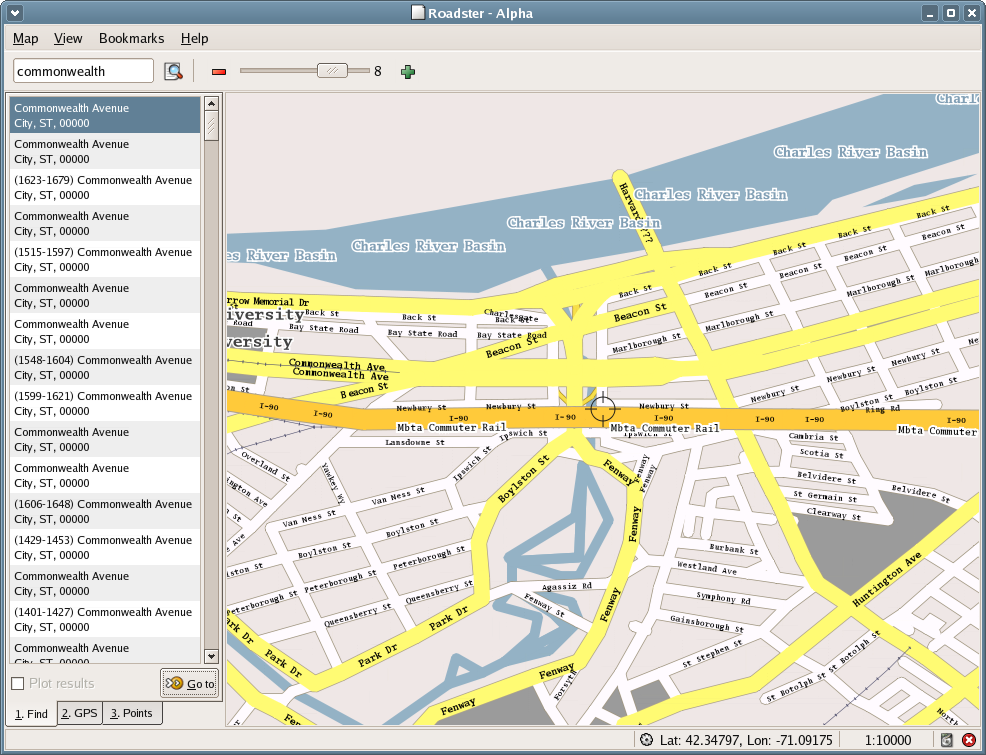
The trip was also an opportunity to meet up with Ian McIntosh, who I had met at the fall Boston Gnome Summit. He is working on a project that I am very excited about. Roadster is a street mapping application for Gnome/Linux much like Microsoft’s Streets & Trips.
Ian is just getting going on the project, but it is already quite promising and has some key potential contributors interested. Carl Worth, maintainer of Cairo, the graphics package that Roadster uses to render map, was quite enthusiastic about the project and eager to help improve the rendering speeds (it’s pretty slow right now). Eric Raymond, who maintains the GPSD package for GPS tracking devices on Linux was also interested. My own friend and co-worker, Nathan Fredrickson is also helping out.
It was fascinating to see a young project spark enthusiasm and participation from people like that. Several people told me that Microsoft Streets & Trips was the only reason they still keep a Windows partition on their laptops and would love and alternative.
Roadster is still a young project, but there is a Roadster website, a development wiki, and a roadster-devel mailing list if you are interested in helping out.
“Companies don’t blog, people do.”