“Choke”
Granted, I have not actually listened to this song. Nonetheless, I’m sending it out to the Toronto Maple Leafs.
“Choke”
Granted, I have not actually listened to this song. Nonetheless, I’m sending it out to the Toronto Maple Leafs.

“Sounds Familiar”
A song about childhood and growing up, which is good and sad and over before you know it. Will either make you want to build a treehouse or hide in your room for a couple weeks.
I’m following Matt’s example and I shall suggest a fine musical group.
Joy Electric is a fine example of analogue synth pop. It grows on you. I liked it because I spent many hours in front of a Game Boy enjoying the musical score to the Final Fantasy Legend series, and I believe that you just can’t beat a good square wave.
I just listened to an unreleased track of Ronnie’s (he’s the frontman, but sometimes he works with others) at mp3.com and suggest that you go take a look.
Monosynth and Parlor Inventor are my favorites.
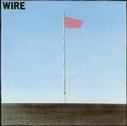
“Strange”
Sludge-punk meets psychedelic stoner-rock. Resulting sound is not unlike a body being dragged across gravel, but funky-like. Road trip ensues.
* For those not in the know:
Artist – Album – Label – Year and “Song”. Dig?
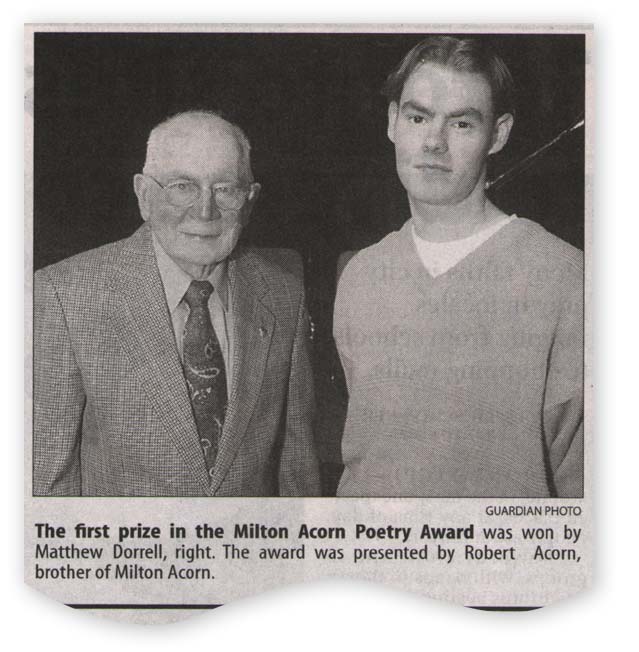
Our own Matt brings home the Milton Acorn Poetry award. Congratulations.
If you are not sure whether or not you should be congratulating him, you can read one of his poems at ForgetMagazine.com and decide for yourself.

In my short 18 years as a television watcher, I have come to the decision that M*A*S*H is one of a handful of shows which I consider to be good. I’m sad to say that I’d watch almost anything if I was bored, but not necessarily enjoy it. Steven likes Northern Exposure. Maybe I should watch it, but I never seem to be sitting on the couch when it’s on.
A lot of people also like “All in the Family” but, I get frustrated at the old guy. TLC has good stuff on it like Junkyard Wars and Battlebots, which I try to watch frequently, but, I often find myself missing stories and learning about characters and watching them develop as they do in M*A*S*H.
Apparently there is a M*A*S*H spin-off with Trapper working at a hospital when he gets home from the war. I guess it wasn’t as good, because we don’t get 2 episodes a day of it on Prime.
I’ll finish this with a quote I found:
“It is amazing how the show is enjoyed by people who were hardly on the planet when we made it. Amazing and terrific.” -Alan Alda (Hawkeye)
(The title is one of Hawkeye’s finest lines, when the OR was shorthanded. But, it’s possible that educated should be intelligent I can’t remember.)
 There are a few fine articles on the FTAA protests in Quebec at ForgetMagazine this week.
I’ve avoided commenting on the protests on aov so far, since the topic is so amorphous (globalization, free-trade, corporate rule, human rights, media, ect.). It’s hard to have a discussion when there are no parameters. However, this isn’t to say that there can’t be meaningful discussion.
I watched CounterSpin on CBC (a fantastic show) the weekend of the protests and felt at the end of the hour that a lot of smart people had made a lot of appeals to emotion. I was left more confused than I was at the start.
George Orwell is cool. 1984 and Animal Farm are staples of the high-school English class. If you read them in high-school, reread them. If not, read them. I was directed to an article Orwell wrote which feels like a hopeful obituary for the English language.
If you do any writing, professionally or personally, you must read Politics and the English Language. I wonder how his comments pertain to web-log writing where there is little editing and the tone tends towards speech. However, anyone writing in any medium should benefit from these ideas.
A few highlights from George Orwell’s Politics and the English Language:
“If you simplify your English, […] when you make a stupid remark its stupidity will be obvious, even to yourself.”
“Words like phenomenon, element, individual (as noun), objective, categorical, effective, virtual, basic, primary, promote, constitute, exhibit, exploit, utilize, eliminate, liquidate, are used to dress up simple statements and give an air of scientific impartiality to biased judgments.”
“The great enemy of clear language is insincerity. When there is a gap between one’s real and one’s declared aims, one turns as it were instinctively to long words and exhausted idioms, like a cuttlefish squirting out ink.”
“What is above all needed is to let the meaning choose the word, and not the other way about.”
I’ve commented before on how the news is mostly distant and without context. One Dead, Three Hurt in California Shooting. Shooting in N.S. town leads police on high-speed chase of suspect. Blah, blah, blah. When something hits closer to home, it will knock me on my ass, but I am unable to mourn the deaths of strangers when all I see is a 15 second video clip.
That said, I can remember a few isolated cases where the TV news really shook me. Vegging on the couch one afternoon, flicking randomly through the channels, an odd pattern formed. Every station started to show the same video feed. For the next half hour I watched, live, as armed FBI agents ushered students from a school in which two gunmen were still stalking. I couldn’t tune it out. It was sickening. I had to turn it off. The strange feeling I had that day, that I was seen something I shouldn’t, has stayed with me.
More recently, four junior-high-school kids were killed in a bus accident in New Brunswick. I sympathized with the survivors. Even now, I am uncomfortable thinking of the horror these kids must be going through.
There’s nothing unusual about being upset my school shootings and tragic accidents, but these two cases are some of the only ones I can ever remember having any impact on me at all. Most news to me is noise. A fire kills a family in Boston, a plane crash kills a celebrity. I could care less. I’ve got plenty to worry about with the people I actually know.
My point? Not sure. Just wondering aloud about selective news sympathy. Why is it that I can watch most news without blinking, however horrifying, while a select few stories keep me up at night?
A random collection of interesting things: