At least once in your life, you should smash a zucchini (3.4MB AVI).
better than the university poster sale
I’ve switched over to using a Mac about a month or so ago, and that has been keeping me from posting for a bizarre reason. But I decided that this site was reason enough for me to fire up the old P3 at home once again.
I was trying to install Gnutella and when I visited its page, I was presented with a pop up. I followed it to find DA Prints. It’s an amazing collection of indie art and photography and you can order them up and get them on your wall rather painlessly.
Check out deviantART for more cool stuff.
Learning about the creative commons
I haven’t felt that I’ve known enough about copyright and patents to have a clear position on the related issues. I have ordered Laurence Lessig’s book, The Future of Ideas, in order to learn more about the issue.
 In anticipation of reading the book, I watched/listened to Lessig’s keynote presentation from this year’s O’Reilly Open Source Convention. It is an excellent presentation.
First, the content of the speech is compelling and powerful. However, I was also struck by the effectiveness of simple visual aids. The presentation is mostly text-based; white text on a black background with occasional selective use of color (only red).
I’ve written, vaguely, about my fascination with the concept that we are, technologically and culturally, standing on the shoulders of giants. When I post to this site, as a simple example, I don’t have think about pixels and packets – someone else has done that for me. This concept that human achievements will continue to improve, which could almost be described as the religion of the western world, relies on our ability and freedom to build on the achievements of others. Lessig’s speech points out how this is threatened by copyright and patent law. More on this as it reveals itself to me.
I strongly urge you to watch/listen to Lessig’s keynote. It is about a half-hour long and is available in Flash, with the visuals of the presentation as well as the audio, or as a standalone MP3 (obviously audio only). Take a half hour and listen to it – not while you work – get comfortable and pay attention. It’s worth it. Don’t bother replying unless you’ve actually taken the time to hear the entirety of the speech.
Thoughts on Winamp3
According to Joel Spolsky (JoelOnSoftware.com), the “single worst strategic mistake that any software company can make” is deciding to rewrite their code from scratch.
Joel was talking about Netscape/Mozilla. Now another of AOL/Timewarner’s children has shot themselves in the foot.
Winamp used to be small, tight, fast, and nimble. It used to whip the llamas ass. Now, in the latest release, version 3.0, which was completely re-written from scratch, it is awkward and unrefined.
Winamp3 doesn’t use standard Windows controls. You can’t Tab through form fields. Over a year ago, I ranted about non-standard user-interface elements, skins, and how these decisions to build proprietary cross-platform interface controls make sense for programmers, but not for users. I could go on and on about this (look at this skin – what the hell is that!?).
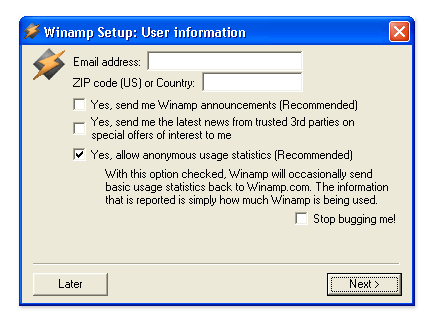 Winamp, the program that pioneered the “Stop bugging me!” checkbox in their installation/registration wizard now puts AOL icons all over the place.
They also win my Most Meaningless Icon of the Week award for their ‘shuffle’ control button. The button looks at times exactly like a ‘volume’ control, and at times exactly like an ‘equalizer’ control. What was wrong with the word shuffle.
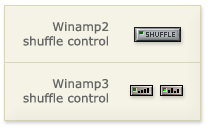
I realize that Winamp is owned by AOL/Timewarner, but if their parent company fails to realize what it was that made Winamp popular in the first place, they will have wasted their $400 million.
The real winner here is Microsoft. Their Windows Media Player has always been bulky and slow. Winamp used to be the light alternative. The other alternatives aren’t looking good either. QuickTime on Windows is a bad port from the Mac version and RealPlayer fell prey to the worst advertising saturation of any application in the history of software to the point where many refuse to even install it.
Having said all of this, it has been pointed out to me that Winamp2 was not very refined when it was initially released either. I’m sure Winamp3 will improve over time as well, but that’s the whole point – they shouldn’t have to improve.
Predictable spam whinning
 There have been endorsements for a spam filter called SpamAssassin all over the web in the past few weeks (see Salon article). As the amount of spam I’ve been receiving has been increasing lately, I tried it out myself.
As I understand it, SpamAssasin in an open source Unix based spam filter (check out that title graphic!). However, an oddly-named company called Deersoft has released a commercial version for Windows/Outlook – that’s me.

I used the program for the free two-week trial, during which it mislabelled one email as spam, and caught at least 90% of real spam. The program also allows you to “Allow” or “Block” any given sender. I was annoyed that you could only allow/block one email at a time. I wanted to be able to go to a folder in Outlook and “allow” all senders (clients, for example).
I emailed Deersoft and requested the feature. I got a quick response acknowledging that this is an important missing feature. A few days later, I got another email letting me know that if I download the update (updates now download automatically), I can now allow/block multiple emails simultaneously. They actually said “ask and ye shall recieve”. Nice.
I’m sure they didn’t implement the feature solely because of my email – it was obviously needed – but I was impressed that they kept my email on file and bothered to let me know of the update. This was enough to make me feel they had earned the $29.95US registration fee – but what really got me to register was the fact that the software works.
While this is a good short-term solution, there are obvious problems with relying on filters for spam. First, the spammers will get smarter, and get good at beating the filters. For example, I got an email last week with the subject line that had something do to with electricians. When I looked at the message, they were not electricians at all, and they were doing nasty things to each other. Also, spam filters make my life easier, but they don’t make life any easier for those that maintain my email server – spam still eats up valuable bandwith and storage space.
I don’t know what to do about spam, but it is certainly pushing me towards other modes of communication. Particularly towards closed, permission based, medium like intranets and instant messaging (between these two medium, I have dramatically reduced by reliance on email).
Perhaps the swelling of spam will encourage the development of more powerful communication protocols. Jakob Nielsen used to talk about giving people, or companies, limited-use tokens to contact you. For example, if you buy a product from Automaton-Waterfowl.com, you give them an electronic token that will allow them to contact you three times (one for a receipt of your order, and two more in case of a problem). This is a good idea.
If anything, you have to give credit to the spammers for their occasional amusing subject lines – and I’m gonna miss getting mail like this.
The Slashdot Lexicon
A Slashdot article about a somewhat deceptive advertising campaign coins an excellent term:
Astroturf (As·tro·Turf)
- A campaign artificially made to appear as though it is a “grassroots” movement;
Usage: “Sony has hired actors in effort to build an astroturf campaign for their latest product.”
Brilliant.
This reminds me of the time Canada’s New Democratic Party did a survey to find out what its members where looking for in a party. It turned out they were looking for honest moral leadership. I wonder if they decided to act on the results.
Floppy Disks: They’re not floppy at all!
Slashdot is running a story on the slow and painful death of the 3.5″ floppy drive. I would like to see the major manufactures start to default machines without a floppy drive. While we’re at it, let’s include an on-board Ethernet adapter by default and lose the parallel, serial, and PS/2 ports too.
As Ben Brown put it so well, “What good is a parallel port!?”
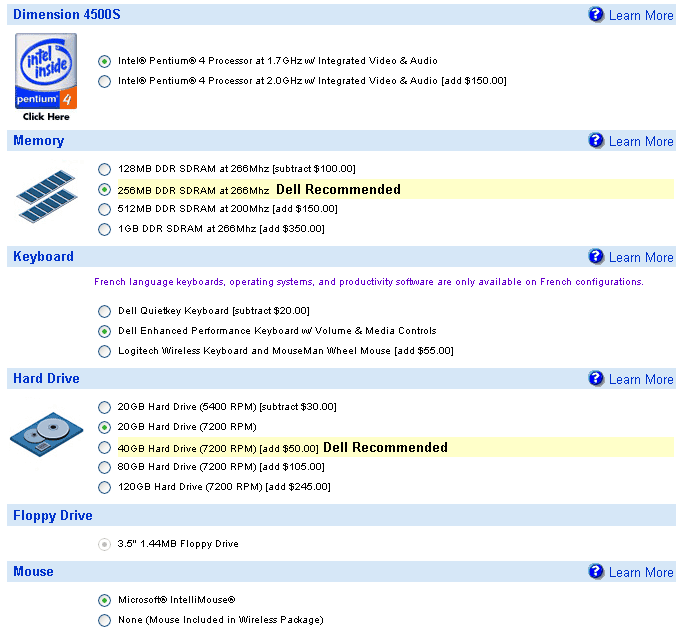
According to PC World New Zealand, “Sony, Dell, Hewlett-Packard and IBM won’t even let you ditch the floppy drive when you customise a standard consumer desktop PC.” Gateway does sell PCs without the floppy drive.
Much respect to Apple, who has way been ahead of the game on this one.

While checking our Dell’s options, I noticed that they now hightlight options as “Dell Recommended” – a nice touch for Mom & Dad who don’t know megabytes from pixels.
Uncharted musical territory
 Chances are you’ve never heard of Mike Knott. He’s been writing and performing in various bands and on his own for at least twenty years. I would include several of his albums in my Desert Island Discs list.
I’ve written before about seeing him live – an amazing experience.
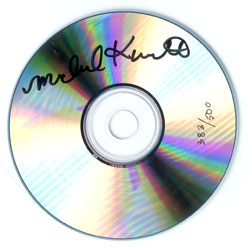
His latest disc has yet to be officially released and distributed with a label. However, he has produced 500 copies for his performance at this year’s Cornerstone Festival. I didn’t make the festival, but he’s selling off the remaining discs on his site and I was able to buy a copy.
It arrived today and I’ve never felt so cool. The disc was obviously made in a CD burner and was labelled/signed by Mike Knott himself. Then, to complete the indie-rock experience, I put the disc into my CD drive – WinAmp opens up and tells me I’m the first Gracenote/CDDB user to use the disc and I have the honour and privilege of entering the track-listing for all the wannabes and late-comers who jump on the bandwagon long after I did.
I am cool.
Conan the Philosopher
“…success is a lot like a bright, white tuxedo. You feel terrific when you get it, but then you’re desperately afraid of getting it dirty…”
– Conan O’Brien,
Commencement Speech to the Harvard Class of 2000
Commencement Speech to the Harvard Class of 2000
Salon Blogs
 Salon.com has always been a great site. I’ve enjoyed their Tech section in particular partly due to the writing of Scott Rosenberg – managing editor of Salon.
In the past year, Salon has slowly slipped from my regular morning routine, generally in favour of independently published weblogs. My routine currently includes, among others, Slashdot, Wired, News.com, Scripting.com, Reinvented.net, Zeldman.com, The Register, MetaFilter, Signal vs. Noise, and Kottke.org.
I’m glad to see Salon jumping into the personal publishing world with both feet with their new Radio Userland-based Salon Blogs service. I’m particularly pleased that Scott Rosenberg himself is leading by example with a weblog of his own.