The intellect of individuals in a group decreases exponentially as the number of individuals in the group increases.
See Garrity’s Law of Eponymous Laws
The intellect of individuals in a group decreases exponentially as the number of individuals in the group increases.
See Garrity’s Law of Eponymous Laws
I have a friend and co-worker who is, among other things, a recovering lawyer (where is there a snare drum and hi-hat when you need it?). Writing about the recent Canadian Supreme Court ruling denying a patent on a genetically modified mouse, he tells me that “each ruling usually has a key paragraph upon which it turns.”
He was kind enough to cut through the 30,000+ word ruling for us and send the following key excerpt. It’s fascinating to see such a formal institution walk the line between the practical and the metaphysical. I think they did well.
163 It also is significant that the word “matter” captures but one aspect of a higher life form. As defined by the Oxford English Dictionary, supra, vol. IX, at p. 480, “matter” is a “[p]hysical or corporeal substance in general…, contradistinguished from immaterial or incorporeal substance (spirit, soul, mind), and from qualities, actions, or conditions”. “Matière” is defined by the Grand Robert de la langue française, supra, vol. 4, p. 1260, as “[TRANSLATION] “corporeal substance `that is perceptible in space and has mechanical mass'”. Although some in society may hold the view that higher life forms are mere “composition[s] of matter”, the phrase does not fit well with common understandings of human and animal life. Higher life forms are generally regarded as possessing qualities and characteristics that transcend the particular genetic material of which they are composed. A person whose genetic make-up is modified by radiation does not cease to be him or herself. Likewise, the same mouse would exist absent the injection of the oncogene into the fertilized egg cell; it simply would not be predisposed to cancer. The fact that it has this predisposition to cancer that makes it valuable to humans does not mean that the mouse, along with other animal life forms, can be defined solely with reference to the genetic matter of which it is composed. The fact that animal life forms have numerous unique qualities that transcend the particular matter of which they are composed makes it difficult to conceptualize higher life forms as mere “composition[s] of matter”. It is a phrase that seems inadequate as a description of a higher life form.
I’ve intentionally avoided posting about politics and policy here on Acts of Volition over the past two years. I’ve done this mostly because I don’t like hearing other people’s half-baked arguments, and figured people didn’t want to hear mine. We’ll, I’m not sure why this situation is any different, if it is at all, but grant me some leeway, it won’t happen often.
Today, Roy Romanow released his government-commissioned royal commission report on the state and future of health care in Canada. The ridiculously short summary of the results go something like this (note: I haven’t actually read the report yet – I’m just relying on journalists):
Public health care is good; let’s pay for it.
I completely agree. The classic demands on government go something like this: more stuff, less tax. Politicians (if you’ll permit my gross generalization) are infamous for promising just that. However, let me be at least one person who’s willing to say I want more stuff, and I’m willing to pay for it. I want a strong public health care system and if you need to, raise my taxes.
The most common response I hear to increasing taxes for funding programs like health is that there is so much waste in government, that they should clear that up and they would need to increase taxes. This is probably true (again with the gross generalizations), but it’s a crutch. It’s not going to happen tomorrow. Health spending and general inefficiency in government are two separate issues. We need to pay for the health care we want.
In his introductory remarks, Romanow stated that medicare is a “moral enterprise, not business venture” – that speech writer should get a raise.
Some links and references for those interested in the report:
The application I use most, besides a browser and email client, is probably Notepad. I have the shortcut to Notepad on my Quick Launch bar and I use it every time I have to take notes of any kind. When I get a phone call at work, it has become second-nature for me to open Notepad before picking up the receiver.
This works quite well. I run into trouble, though, when it comes time to reboot or shutdown. I’m running Windows XP on a laptop and I don’t often reboot (I use the suspend status when moving between home and work). It’s a good nod to the stability of 2000/XP that I’m confident leaving notes unsaved in Notepad for days at a time. However, when I do have to reboot for some reason, I’m forced save all of my open notes. I end up having to litter my desktop with temporary files and folders. I’m also forced to name each of the notepad files (usually ending up with useless names).
I want a Notepad that has no Save command. I want everything to always be saved, all the time.
Some argue that the whole concept of saving files is vestigial and should be scrapped. There is definitely something to that. The most common counter-argument to that position is that it limits the ability for experimentation with files (you can try things out with a file without saving). This is bunk. Reverting to saved versions of files is not a good model for experimenting. That’s what universal undo/redo is for. Allaire’s ColdFusion Studio allows undo beyond the last save. Adobe Photoshop (version 6 & 7) implements a history system that works well (despite some nasty implementation quirks).
When I’m typing longer items, like this post, I usually use Microsoft Word. I have the Save command keyboard shortcut burned into my brain (Alt+F+S). I press it instinctively after almost every sentence. Can’t a robot do that for me?
Bill Gates smells my desire (that sounds obscene, but it’s not) and his minions are on the case. At Comdex this month, they previewed a new app called OneNote (say it out loud: wa’note – I’m not yet sure if this is clever or stupid). It won’t be available until next year (I’m signed-up for the beta in early 2003).
I won’t rehash the description of OneNote here. For details, see the WinPlanet article, Steve Gillmore’s InfoWorld article, and the official Microsoft OneNote site featuring a video of the announcement (300Kb/s Windows Media) worth watching if only for the terrible ‘acting’ by the presenters. If you can get past the embarrassing presentation, this video does a good job of demonstrating OneNote. You really have to see it in action as the benefits are difficult to explain.
Of interest here is a notable omission from the OneNote toolbar: no Save icon. As stated in the WinPlanet article: “The program always launches or opens to your most recent page of notes, while an auto-save function reduces fussing with filenames.” Yup, that’s what I want.
On a bit of a tangent, OneNote is an interesting step towards the “universal canvas”. The ‘canvas’ is powered by the Office apps (Word, Excel, etc.). I see (very) faint glimmers of Jef Raskin’s Humane Interface here. Let’s just hope it isn’t big, bloated, and stupid.
Today we have a lesson in how to screw up a good thing. I’ve been a long-time user of instant messaging. It started with ICQ, and though it was mostly a novelty at the time, it was clear that this was a major shift in online communications. I still use ICQ primarily, but sneaking in as a default install with XP, MSN Messenger was slowing winning me over. I would have switched completely, but the lack of an archive of messages was a deal breaker.
 This was MSN Messenger 4.x. When Messenger 5.0 became available, I updated. It was a mistake. Here’s why.
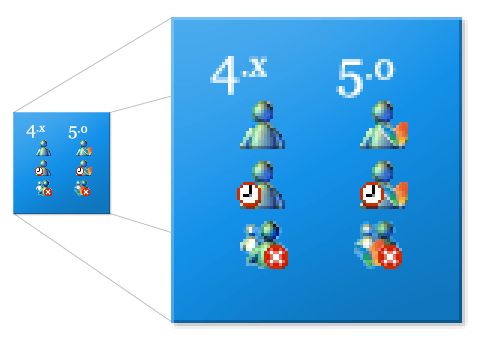 The icons in Messenger are important, as they are one of the new icons that are always on the screen. The new 5.0 icons include the MSN Butterfly. For the record, I’m not totally anti-butterfly. The full-size MSN Butterfly icon included in system32/shell32.dll in XP is absolutely beautifully rendered. However, the tiny butterfly added to the 16×16 pixel system tray icon is too easily confused with the offline or away status indicators. It is too small to decipher, and just adds clutter.
I’m a confessed upgrade junkie. Sometimes it burns me.
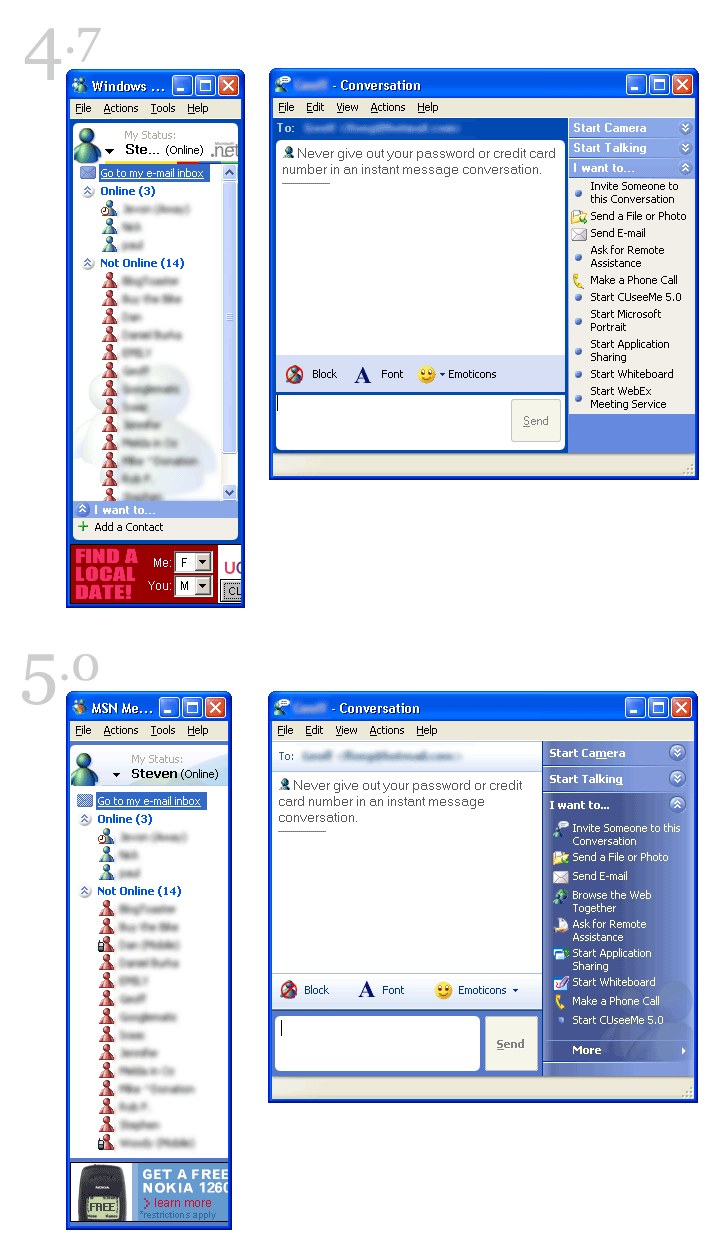
Microsoft’s UI design teams seem to need to implement an entirely different interface scheme for every product line. Take a look at this comparative screenshot of version 4.7 and 5.0 (also note one of the new improvements in v5.0 – the better layout of the My Status area at the top of the Messenger window). Office and XP look different and all of the MSN stuff seems to be happening in a bubble somewhere (a heavily bevelled bubble, I would imagine).
This reminds me of the politics and positioning that takes place between federal, provincial/state, and municipal politics. There is only one tax payer. There is only one user.
Amazon is now taking preorders for Segway Human Transporters!!
Those things are real! And this March you’ll be seeing doctors, lawyers, and trendy internet punks screaming everywhere.
If you want one, it’ll set you back about five thousand American dollars. I’m not sure if that’s a good deal for a human technoscooter or not. Perhaps a stink should be raised on the topic of them being a monopoly.
Sadly, I feel I’m in the wrong environment for said scooter. If they can put skis on it for slushy swampy environments, I’d love one. Perfect for a tiny little town or campus.
But 5000$… I guess we’ll have to start up with X10 popups on AOV.
The only thing that will make you better known than making sweeping declarations, is making sweeping declarations and naming them after yourself (see Garrity’s Inverse Law of Congregational Intelligence). Joel Spolsky writes about The Law of Leaky Abstractions. He should shirk humility and call it Joel’s Law of Leaky Abstractions.
Unfairly simplified, Joel’s point is that you have to understand abstractions to use them effectively. You have to know how the tool does what it does to deal with problems and not to be bound by the abstraction. I enjoyed reading Joel’s thoughts – and they are good points. Ignorance of the meaning of abstractions is often the cause of one my least favourite business problems: “the computer won’t let me do that” (I’m getting mad just thinking about hearing that).
Joel correctly points out the weakness of abstractions. It can be helpful to know that when your turn the steering wheel in your car, you are not just pointing the car in another direction. Rather, you are turning the front wheels (unless you have that crazy-ass four-wheel steering) and the motion of the car and the friction of the wheels against the road is what makes the car turn. It’s good to know this when you are turning ice, for example.
This is exactly what WYSIWYG HTML editors don’t work very well.
What Joel doesn’t talk about, perhaps because it goes without saying, is how incredibly powerful abstractions can be. I often find myself saying things that go without saying.
I’ve always been fascinated by abstractions. It seems to be that abstractions could be our most powerful tool as a species. When I have to know how everything works, I am bound by the practical limits of what one person can come to know and understand in a lifetime. Print and transportation have made it easier for one person to learn more, but you can only read so many books. So in order for us to do amazing things like build bridges that go farther than you can see, or go to the moon (if you buy that story), we need to abstract. We need to rely on the knowledge and capacity of others. We use each other as tools.
In a previous post about abstractions in science, I wrote*:
When I call on a simple PHP function to show the date on a website, I don’t need to understand how PHP is interpreted. I don’t need to understand the network protocols used to transmit the process page to your computer. Basically, I don’t need to understand how computers work because someone else has done it for me.
I’m not sure what the move to abstractions means for us in the long run. It is certainly enabling us to do things on a grander scale. However, it also removes us from the source of our activities. Take food, for example. We seldom see where our food comes from or where it ends up. I could never gut a chicken, but I sure do like the mandarin chicken salad at Wendy’s (does a chicken even have a ‘gut’?).
Perhaps Joel is right; In order to use abstractions effectively, we need to truly understand them. Understanding an abstraction doesn’t mean you can’t take advantage of it. You don’t need to think about it all the time (that’s the point). Rather, you just need to be able to understand the abstraction when it breaks down (or ‘leaks’, to use Joel’s term). When your Subaru is sliding towards a ditch, for example, it helps to know why you steer into a skid.
 This Veterans’ Week Canada remembers its veterans of the Korean war, the First World War, and the Second World War. Also see the CBC’s coverage.
If you catch this post by 11AM Atlantic time (10AM Eastern), you can watch the ceremonies in Charlottetown on the webcam.
I’ve been informally documenting the robot take-over of the world on this site for the last few years, and it took a big step forward this week. A U.S. pilotless drone fired a missile, killing six people in Yemen. I don’t want to make a joke of this – people were killed – but holy crap, a pilotless drone!?
Isaac Asimov’s laws of robotics are actually becoming pertinent. Everyone should rent Toys this weekend.
About five months ago, I called on fans of the Northern Exposure TV series to sign a petition for the release of the complete series on DVD. Since then, over 1000 people have signed on. People did more than just sign their names. Many have enthusiastically shared what it was they loved about the show.
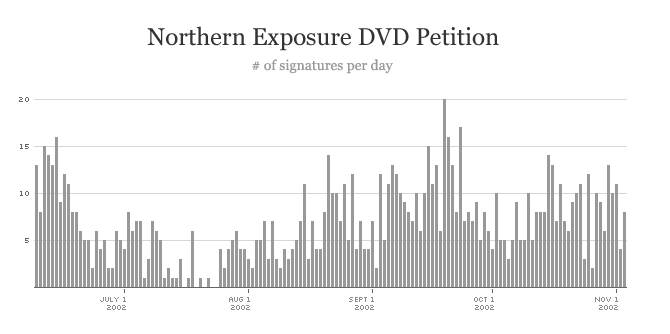
The petition seems to have peaked in September (with links from some fine NX sites). I’m sure people would keep signing up, but I think we have enough to make a point (as small a point as it may be). The chart below illustrates the number of signatures per day over the course of the petition (see full-size version).
The petition is now closed. If you didn’t get a chance to sign up, or if you did and want to do more, there is another NX DVD petition to which you can add your name. I’ll be sending the petition to the appropriate parties (if I can find out who that would be) and I will post any pertinent responses.
To all who linked to and signed the petition, thank you. To those other readers who couldn’t care less about Northern Exposure, thanks for bearing with us (and occasionally deriding us); this should be the last you hear of it for a while.