Looking for a job? How about Director of Highway Safety & Information Technology?
Acts of Volition Radio: Session Two
 The reaction to the first session of Acts of Volition Radio was generally positive. Here, then, is Session Two:
Nine great live recordings. Recorded during a snow storm on Sunday, December 7, 2003 by Steven Garrity. Run time: 1hour.
Session One Playlist:
- Jellyfish – Ghost at #1 (live)
- Ben Folds & John McRae – Fred Jones (Part 2) (live)
- Ben Folds – Brick (live)
- Sloan – Deeper Than Beauty (live)
- Pearl Jam – Yellow Ledbetter (live)
- Tragically Hip – Nautical Disaster (live)
- Radiohead – True Love Waits (live)
- U2 – The Fly (live)
- MxPx – KKK Took My Baby Away (live)
Some technical notes: I will try to get one of those foam microphone covers before the next recording to try and cut down those annoying punchy ‘p’ and ‘t’ letters. Does anyone with any recording/engineering experience having any advice? Should I be compressing or normalizing the voice tracks?
Also, there is an RSS feed for the Acts of Volition Radio posts.
Next week: an hour of name-dropping – songs by people I’ve actually met – and maybe an interview with the president of the internet.

/
RSS Feed
Beautiful interactive ShockWave flight
Version 0.4 of the Mozilla Thunderbird mail client is out – an update to the Luna Blue theme is coming soon
Christmas tip: use egg nog in your coffee instead of cream
Photos of Peter Rukavina’s house from 1904 and 2003
Acts of Volition Radio: Session One
 I’ve had the idea of doing a weekly radio show on the web floating around in my head since the Acts of Volition website started over three years ago. I like the idea of assembling a bit of music, talking about who it is and why I like it, and making it available for download. An hour show could be posted for download and those interested could listen at their convenience (much like we enjoy the Strong Bad emails at HomeStarRunner.com or a new edition of The Onion each week).
I finally got around to trying it out tonight. I’m unclear on the licensing issues, but if I have to, I will pay the appropriate licensing fees if and when I can figure out what they are.
So, here you have the first ever edition of Acts of Volition Radio:
Six fine songs and me talking about them. Recorded Friday, November 28, 2003 by Steven Garrity. Run time: 34min 30sec.
Session One Playlist:
- The Postal Service – Nothing Better
- The Weakerthans – (manifest)
- Brad Sucks – Making Me Nervous
- Pedro the Lion – Magazine
- Apollo Sunshine – I Was On The Moon
- The Darkness – I Believe in a Thing Called Love
/
RSS Feed
Notes from New England
 Having recently returned from a quick road trip to New Hampshire and Boston with a few co-workers, I have a few observations:
- Trip highlight #1: Early into the trip, Isaac looks up from his Globe & Mail crossword puzzle and asks, thoughtfully, “How do you spell thar, as in ‘Thar she blows’?”
- Trip highlight #2: After walking for quite a while in Boston, we asked a couple on the street for directions. “Can you tell me how to get to the New England Aquarium?” The couple looked a little confused and replied in a thick Eastern European accent, “The Aquarium is in Boston.” Apparently we were now in Cambridge.
- Daniel worked on his weblog down the entire I-95.
- If you have a criminal record, as did the unfortunate soul in front of us in line at U.S. Customs & Immigration, you will be questioned about it in detail in front of others in the waiting room. Even if it’s a marijuana possession charge from 1981.
- There are enormous and unflatteringly close-cropped portraits of George Bush in the U.S. Customs offices.
- There are a lot of Howard Dean for President signs in New Hampshire.
- The otherwise fine Lakeview Inn has a misleading moniker.
- Boston folk are friendly: A girl who looked a lot like Kelly Osbourne had no qualms about reading over my shoulder in a coffee shop and critiquing the salutation I chose to open an email I was writing to my girlfriend.
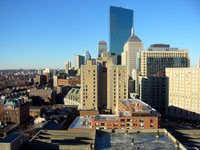
- The Boston skyline at night is something to behold (here’s a photo of Isaac beholdin’ it).
- It is indeed possible to take in both an IMAX 3D show and an OmniMax show in the same day (use of the subway may be required).
- The Old Country Buffet is to be avoided.

DeltaTangoBravo.com? Roger that.
Though I’m usually glad to take most of the credit, much of my professional and personal design work is often the better for having been subject to collaboration and criticism from my co-workers.
After much teasing/coaxing/punching, my professional better half at silverorange, Daniel Burka, has finally joined the world of weblogs. His site, DeltaTangoBravo.com just went up this morning and already busting with coolness. Fans of the silverorange design aesthetic (if there is such a thing) will recognize Daniel’s signature style.
So far, he has pointed to an amazing set of Tufte-esque illustrations (beautiful) and regaled us with the sad tale of putting his new digital camera through the washer (and dryer).
Welcome to Daniel, and to those who enjoy all things smart and good, get over there and syndicate that thing.