Police spoil Super Bowl parties – That’s my dad!
Responsibility and Accountability in Software Development
Microsoft is being criticized by Amnesty International for supplying “goods and services” to China that was used to violate human rights. Cory Doctorow, of the Electronic Frontier Foundation (and an excellent sci-fi author), brings an interesting perspective to the situation.
Microsoft states that they are “focused on delivering the best technology to people throughout the world. However, how that technology is used is with the individual and ultimately not in the company’s control.”
Doctorow points out that “[t]his is a curious rationale from a company that is shoving DRM down its customers’ throats, effectively telling the entertainment industry that it believes that it can and should control how its users use its products.”
Curious indeed. This is an issue that the open-source/free software world has had to deal with this issue as well. It is a tenant in the open-source world that one should not descriminate against uses or users of their software. As our local ISP owner, Kevin J. O’Brien would say, “it’s just data”.
The venerable Open Source Definition by Bruce Perens states that:
The license must not discriminate against any person or group of persons.
…
The license must not restrict anyone from making use of the program in a specific field of endeavor. For example, it may not restrict the program from being used in a business, or from being used for genetic research
Is someone who makes a tool responsible for how it is used? Guns and other arms manufacturers obviously come to mind.
As for Microsoft – if they sell Microsoft Windows to government (foreign or domestic) and it is then used to organize evil plots, then Microsoft can hardly be held any more accountable than the people who build buildings for the same governments. However, if Microsoft is paid to provide services, such as installation, customization, or consulting, on projects that are obviously in violation of human rights, then they are indeed in the wrong.
Acts of Volition Radio: Session Five
 Session five of Acts of Volition Radio is all about great guitar rock songs. This is a good one to burn to a CD and play in your car.
A collection of great guitar rocks songs. Recorded Sunday, February 2, 2004 by Steven Garrity. Run time: 45min.
Session Five Playlist:
- Aunt Bettys – Rock and Roll
- Catherine Wheel – Way Down
- Foo Fighters – Hey, Johnny Park!
- Matthew Sweet – Sick of Myself
- Pearl Jam – Given To Fly
- Poor Old Lu – For the Love of My Country
- Smashing Pumpkins – Here Is No Why
- The Age of Electric – Ugly
- Weezer – Say It Ain’t So
If this is your first time hearing Acts of Volition Radio, you may enjoy previous four Acts of Volition Radio sessions as well.
The process of recording and assembling the radio sessions is getting easier each time (and hopefully better).


/
RSS Feed
A smart and well-written article about Linux, aimed at non-technical readers
8-year-olds review rock classics – they like Nirvana, and like that Bob Dylan said “bums”
Europe still has cooler cars than North America
cartophilia: “what makes Oklahoma so desperate to touch New Mexico?”
The Zen of Palm: old but great documentation about what made (makes?) Palm a good and usable platform
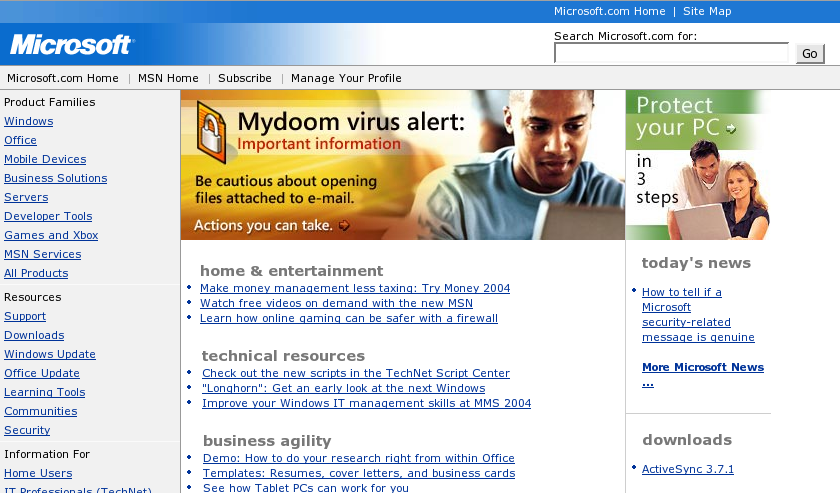
Microsoft acknowledges a virus on their home page
The latest email virus that has been filling up our inboxes is brining all kinds of bad press down on Microsoft (and rightly so). However, I have seen one, however tiny and insignificant, gesture that Microsoft should be lauded for.
The Microsoft.com home page, as of this writing, features as the most prominent page element, a large item linking to information about the Mydoom virus (here’s a screenshot of the home page, as I’m sure it won’t stay up there for long). While this is, of course, the least Microsoft can do, it’s nice to see them putting the information that people are actually looking for right up front.
Acts of Volition Radio is on the agenda for tonight’s Berkman weblogger meeting at Harvard