A deliciously sacrilegious Easter cake
Laurence Lessig links to the rejection of a copyright extension that would have locked up Anne of Green Gables for another 15 years
Studio Sessions from CBC Radio
I wrote a little over three years ago about some strange things afoot at the CBC. I was impressed at the time by their experiments in new media, and I remain so. In particular, I’ve been enjoying the many live concerts and studio sessions recorded for CBC Radio. Many of these sessions end up on the site JustConcerts.com.
The CBC has a well-deserved reputation for great audio production. As several of these sessions clearly illustrate (particularly the Sarah Harmer and Hawksley Workman sessions) the talent of the CBC recording engineers.
In hopes that you might enjoy some of the sessions that I have enjoyed, here are some of my favourites from the CBC’s JustConcerts.com:
 Sarah Harmer in session, January 29, 2004
- A great example of CBC Radio recording. You can hear here fingers on the guitar strings and if you close your eyes, you’d swear she’s sitting in the room. Sarah plays tracks from her new album. Track of note: “Almost”.
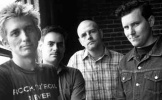 The Weakerthans at Lee’s Palace in Toronto, November 6, 2003
- The Weakerthans played three nights in a row at Lee’s Palace in Toronto. I saw the third show – this was the first. The site also has two other great sessions with the Weakerthans: John K. Samson (lead singer) in session in December of 2002 (this is one of the rest recordings on the site – amazing) and a great older show, The Weakerthans in session in May of 1999.
 Hawksley Workman in session, October 15, 2003
- More great CBC Radio audio production. Performing tracks from the remarkable Lover/Fighter album. Look for Workman in future sessions of Acts of Volition Radio. Track of note: “Autumn’s Here”.
 Buck 65 in session, March 11, 2002
- This guys is way more east coast than Jay-Z. Buck 65 is more of a story-teller than a rapper. I’ve yet to have the opportunity to see him live, but my friend Geoff always seems to always be hanging out with him
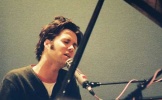 Rufus Wainwright in session, December 15, 2003
- Recorded in the CBC Studio 2 in Vancouver in front of a small studio audience.
A few other sessions and concerts that look promising, but I haven’t had a chance to listed to yet:
- Joel Plaskett in session in November, 2003
- The New Pornographers in session in November, 2000 (includes video)
- The New Pornographers at Richards On Richards in Vancouver in June, 2001
- Hayden in session in June, 1998
- Stephen Malkmus and the Jicks at Lee’s Palace in Toronto in May, 2003
- Frank Black and the Catholics at The State in Regina in April, 2003
- Gomez at The Commodore Ballroom in Vancouver in October, 2002
- The Breeders at Lee’s Palace in Toronto in July, 2002
- Andrew W. K. at Richard’s on Richards in Vancouver in June, 2002
- The White Stripes at The Commodore Ballroom in Vancouver in June, 2002
- Mogwai at Lee’s Palace in Toronto in May, 2002
- Cranes at Luv-A-Fair in Vancouver in May, 2002
- Billy Bragg at The Commodore Ballroom in Vancouver in April, 2002
- Mike O’Neill at The Horseshoe Tavern in Toronto in May, 2001
- Badly Drawn Boy at the Starfish Room in Toronto in November, 2000
Google knows about the golden ratio
File sharing and the music industry debated on CBC Radio’s Cross Country Checkup (RealAudio or MP3 hour 1 & MP3 part 2)
Great example of misleading newspaper layout
I was invited to a music-sharing group recently – here’s the tracklist of the CD I brought
Kinja as Free Public Weblog Aggregator
 As with many other curious webloggers today, I tried out Kinja, a new web-based RSS aggregator tool. It is intentionally simple, not offering the power of most other aggregators in favour of being more palatable to new users.
After trying it out, I was a bit surprised to see that my list of sites was automatically shared to the public. I don’t mind sharing my site list, and I even do like the idea of having lists be shared by default, but I would have appreciated some warning.
Then, while reading some of the rationale behind Kinja, the mention of how it was modeled after the format of a weblog, in reverse-chronological order, led me to think that Kinja could work well as a free weblog aggregator for public consumption, rather than just personal use.
More and more aggregated weblogs have been cropping up lately, especially in the open-source development world. For example, there is an aggregated Gnome weblog, an aggregated Fedora weblog, and many more. There is even an open-source project to develop the code behind these aggregators. Well, Kinja may be a quick and simple way to produce an aggregated weblog.
Setting up an account does require an unique email address (I have email addresses up the wazoo, so this wasn’t a problem). As an example, I created an aggregated weblog for the Weblogs of 84 Fitzroy St. — the building in which I work along with several other webloggers.
While I don’t expect this is really the intended use of Kinja, it can only be good for them, since their revenue is generated by advertising. The only thing that is really missing is having an RSS feed of the aggregated weblog — something I can imaging Kinja doesn’t have because it is already an RSS aggregator. Maybe they’ll add feeds for this purpose.
Update: Perhaps this is obvious, but something I forgot to mention in my original post: many weblog platforms allow you to have RSS feeds per category. So, if there were a group of weblogs that all talked about their cats, and about technology XYZ, you could aggregate the RSS feeds from their “technology XYZ” categories and people interested could get the groups view, without seeing pictures of their cats.
Using the future to sell the present
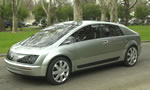 During a recent conversation about software upgrades (to which I am a confessed addict), a friend made the profound statement that “everyone loves the future.”
Perhaps you’ve seen the recent television advertisements in which GM promotes their oddly-spelled “hy-wire” concept car. As Wired News reported in September of 2002, the concept car promises a future based on hydrogen fuel cells.
It is nothing new for auto companies to use concept cars to generate press and attention. However, I find this most recent advertising campaign a bit offensive. GM is using the promise of an eventual product to sell completely unrelated products today. Does the Hy-Wire work yet? Is the one we see in the TV commercial actually powered by fuel cells?
The premise seems to me to be something like “someday we’ll make a great car that’s environmentally friendly — in the mean-time, be sure to pick up a new Cavalier or Escalade”.
Community-produced audio recording of Laurence Lessig’s New Book
 Having enjoyed Laurence Lessig’s previous book, The Future of Ideas, I was looking forward to his latest book, Free Culture. The text of the book is available for free online. While I have read long works from my laptop LCD, this 352-page PDF file didn’t seem very appealing on screen.
I thought it would be nice to have an audio-book format. I even considered recording it myself – which would be acceptable considering the Creative Commons license on the book. However, I didn’t have the time, energy, or more importantly, the talent to do a good job at recording this.
With this in the back of my mind, I came across a post by Cory Doctorow on BoingBoing about a weblogger-produced collaborative audio-book recording of the new Lessig book.
Now, only a few minutes after wondering if I should produce this myself, I’m listening to Chapter 1. Cool.