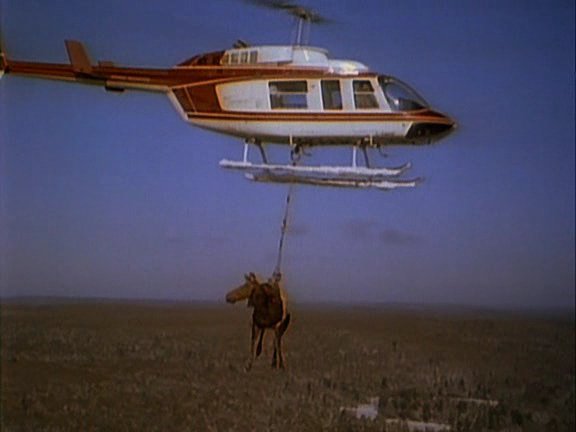
A shot from episode 16 from season 5 of Northern Exposure. Just because.
A shot from episode 16 from season 5 of Northern Exposure. Just because.
My good friend Peter Rukavina is always experimenting with web and mobile technologies. Often his experiments are best kept at the experimental stage, like the Open Bread project.
Other times, his experiments can prove quite powerful. He’s been a canary-in-the-coal-mine of geo-location. For example, he’s been documenting his physical location/status with the Plazes service. Today he has taken another step in that direction by setting up his own mobile website.
The phrase “mobile website” usually implies a special version of a website that is tailored to small screens and low-bandwidth. In this case, it’s not the visitor that’s mobile – it’s the website itself.
His mobile site, ruk.mymobilesite.net gives you a way to see his status, know if he’s on the phone, leave him a text-message, etc.
Back in 2003, I wrote (in a post cleverly titled Is that a web-server in your pocket?) about this very idea. I wondered if it was possible, and if it would be useful. Seeing Peter’s version of the idea in action made a light go on in my head. I think we’ll all have something like this in a few years.
Don’t worry, this wont turn into a baby-blog, but for the time being, that is my world. In looking at cloth diapers, I’ve stumbled across another delightfully odd branding sub-culture. It seems the world of cloth-diaper branding rivals the generic-brand cereal names in delightful absurdity.
Here’s a list of actual cloth diaper brand names:
I thought of a few of my own:
(trademark symbols used for levity only)
As our lovely little girl, Anna, came early, we had to spend a few extra weeks in the hospital with her. My wife and I learned a few things:
Giant animals from the ice-age. I’ve always been terrified of giant sloth. They’d rip your face off, slowly. Also: 9-foot beaver and the bird that Gandalf rode in Lord of the Rings.

The Zap Your PRAM Conference coming up in October is shaping up nicely.
Confirmed attendees so far include MetaFilter founder Matt Haughey, Mozilla Marketing VP Paul Kim, Lead Designer from Last.fm Hannah Donovan, openUsability founding member Peter Sikking, Internet Rock Star Brad Sucks, and more.
Rumour has it Brad is bringing his guitar.
All the while our stately venue awaits our arrival, growing more historic by the minute. Literally.
While recently ranting about the office in my usual manner, I conceived of a scheme to write a series of one-phrase letters to the editor of our local paper. The purpose was vague, but the results would be hilarious. If only I had the attention span top follow through on such schemes.
 A friend and co-worker took the idea a step further. Why compose a complete and coherent “Letter to the Editor” 140 thoughtless characters will do the trick? He termed it “Twitter to the Editor”.
Somehow, despite not having the attention span to compose an email, we built a website for the idea. Thus, TwitterToTheEdtitor.com.
Just send a Twitter or Identi.ca message starting with @ttte and in a few minutes, it will be collected on our stately one-page website.
Don’t think too hard about it. Here’s a few Twitters’ to the Editor that we’ve started off with:
While in the hospital with our perfect new baby, we were given a catalogue for a photographer that takes baby pictures. One of the services offered is creepy beauty-magazine-like, skin smoothing, blemish removing, photo retouching.
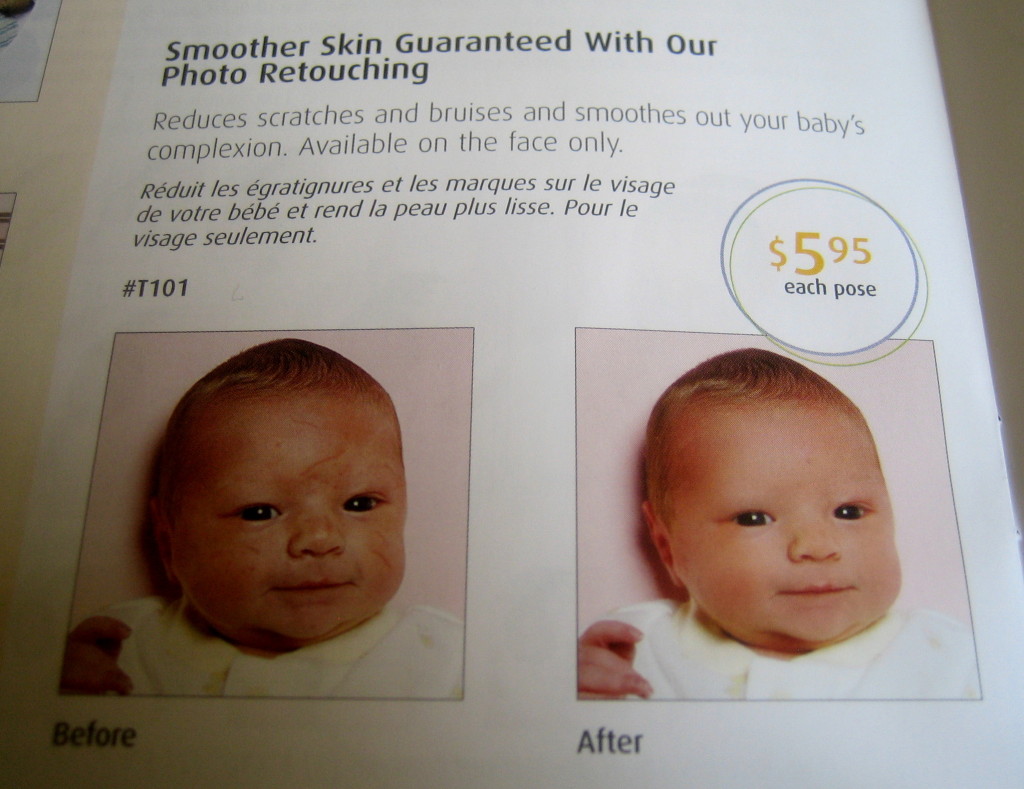
Just in case your baby wasn’t already born with a body-image problem.
The 2008 Mozilla Summit is happening in Whistler, British Columbia, this week (I was going to be there but had a baby instead). A massive rock-slide has closed the road from Whistler to Vancouver, stranding loads of travellers.
Resourceful nerds that they are, the Mozillians have filed a bug in Bugzilla to address the situation.

A summer session of Acts of Volition Radio with 2/3rds Canadian content.
For more, see the previous Acts of Volition Radio sessions or subscribe to the Acts of Volition Radio podcast feed.