It’s all trade-offs

The further I get through life, the more I realize that most things in live can be seen as trade-offs.

Some things are obviously trade-offs. Should you take that new job? On one hand, you’ll get better pay. On the other hand, you may not get on as well the the team as your current job.

Beyond the obvious cases, I’ve come to believe that everything is a trade-off. On top of that, we usually don’t have a great sense of what we’re trading off.

Obviously-bad choices are just trade offs that are weighted against our preferred outcome. Obviously-good choices are trade offs that are weighted to our preferred outcome.

I find thinking of things as a trade-off helps with post-decision regret. If you made a big decision and it’s not perfect, just remember that this decision had trade-offs, and any other choice would have just had a different set of trade-offs (maybe much worse).


Computers are solid now

My MacBook Pro froze the other day. Like, really froze. The cursor didn’t move, the keyboard didn’t do anything, and even the haptic feedback that makes the touchpad feel like it “clicks” didn’t trigger. This frozen touchpad added a physical layer to the freeze. It felt almost like it would if you could no longer physically depress keys on a keyboard.

What surprised me most about this computer freeze was that I was surprised at all.

Years ago, a computer would easily freeze a couple of times per week, or per day. It was frustrating – but not surprising. It was frustrating how unsurprising it was.

Sometimes it seems like everything is getting worse (and in many ways, things are obviously getting worse). In one small corner, stability on a typical computer, things have gotten better.


Resumability

Resumability is not a word, but it’s an important concept to me.

When I say Resumability, I’m talking about the ability to quickly interrupt and later resume a task.

The task doesn’t have to be productive. The greatest resumable device I’ve ever owned is the Nintendo DS.

The DS was a clamshell-shaped portable gaming system. If you needed to stop playing, you could just slam the case shut (with a satisfying clunk sound).

Two hours (or two days) later, you could flip open the DS and you were immediately exactly where you left off. You could just un-pause and keep playing as though no time had passed.

There was no boot up, no menus to navigate, no agreements to confirm. You just keep playing.

When you’re a tired parent without much time for video games, resumability is key. If it’s going to take me two or three minutes to get into the game, I may have just used up half of the time I had available in the first place.

Other devices that are good at resumability:

  • Most dedicated e-reader devices like the Kindle or Kobo resume exactly where you left off.
  • Modern smart phones: Press an Off button, slide it in your pocket, take it out later and unlock it with your fingerprint or face, and you are exactly where you left off (feeding your dopamine addiction at the cost of your relationships and connection to society)
  • Slack, the work chat app, is resumable even across devices. If I’m in the middle of typing a long message and my laptop flies out of my hands into the ocean, I can pick up where I left off from my phone.

Sometimes resumability needs to be designed into a device, like the examples above. For some types of devices, they are resumable by their very nature. A book with a bookmark is always ready to go. When you pressed STOP on an old audio cassette player, it just sat there in a physical arrangement ready to resume exactly where you left off a year later.

We don’t always want such a friction-less experience though. Friction is safe. It keeps you from falling down. Friction in an entertainment device, can also help keep you from excessive unwanted distraction.

If my TV takes 20 seconds to boot up, that might be just enough friction to keep me walking past it rather than getting sucked into watching something I don’t even really want to see.

Just don’t make me wait 3 seconds to resume my New Super Mario Bros. game.


Unintended consequences of net metering

Where I’m so fortunate to live, on Prince Edward Island, we have a Net-Metering system for electricity (see the legal act). My oversimplified explanation of PEI’s net-metering policy is:

  • For any energy my solar panels generate, but that I don’t use gets shared back out to the grid.
  • For any unit of energy I share back to the grid, I get a credit for that same amount of electricity.
  • The credits are 1-to-1 value, with the caveat that we pay tax on the electric bill before credits are applied
  • Credits can’t be carried year-over-year, and credits can’t be exchanged for cash value

A 1-to-1 credit system like this is pretty good. It means I benefit of every bit of energy I can generate even if I can’t use it at the time. Economically, at least it’s like the entire grid is my infinite battery, that I can charge up when it’s sunny, and draw from whenever I need.

The unintended consequence for this type of pricing is that I now have no financial incentive to do any electricity storage myself. I could pay $15,000 or more for a home battery system that would allow me to keep much of the surplus energy I generate and use it during hours when I’m using more, but generating less.

If there wasn’t a net-metering system, I’d have an incentive to get my own storage, but net metering is great. I don’t want to lose it.

Two incentives I can imagine would help people like me get home battery storage:

  1. Vary electricity costs (charge more during higher demand). A smart battery system could draw down my battery during peak rate times. This would save me money and reduce my draw on the grid at key times. As a human on a warming planet, I want this. As a consumer – I don’t want to have to think about the price of energy at different times of the day.
  2. Just pay me. If we want to reduce the draw on the grid at peak times, we could have the government incentive residential storage costs.

One other relevant thing to note (thanks to Steve for the tip in the comments): One of the first things you learn when you get solar panels (without some kind of battery storage) is: when the power goes out, your solar panels don’t work. A common residential solar installation without a battery storage component requires grid power to function.


The 1,000 Day Stopwatch

It turns out that if you start a stopwatch in the Clock app on macOS, it will keep counting through reboots and upgrades. As of today, my stopwatch has been running for over 1,000 days.

I wonder what it was I was originally timing. Looks like the first ‘lap’ was 100 days long.

Screenshot of macOS Clock app showing a running time count of 24000:48:44.87.
 

Don’t prescribe values to the weather

I have a pet peeve about people talking about the weather, particularly on the radio, which is where I hear most of my weather-talkin’.

You’ll often here the weather-person express a kind of value judgment on the weather: it’s going to be a ‘nice day’, or the weekend ‘looks good’, or they have ‘good news in the weather forecast’.

The thing is, there isn’t good or bad weather.

Ok, there can be bad weather. No one wants a tornado or a flood.

Other than those extremes, though, weather isn’t good or bad. It depends on your preferences and needs.

Throwing an outdoor wedding reception? You probably don’t want rain. Trying to keep failing crops alive after weeks of drought? You probably do want rain.

I know people who love a hot and humid day. They call it a “beach day”. I hate hot humid days. I can only take off so many clothes.

This is mostly trivial peeve of language, but I do think there’s a deeper issue. If we prescribe values to something as arbitrary as the weather, then we allow something which we have no control to impact how we feel.

Don’t value judge the weather! It’s is a path to sadness!


Meetings need margins

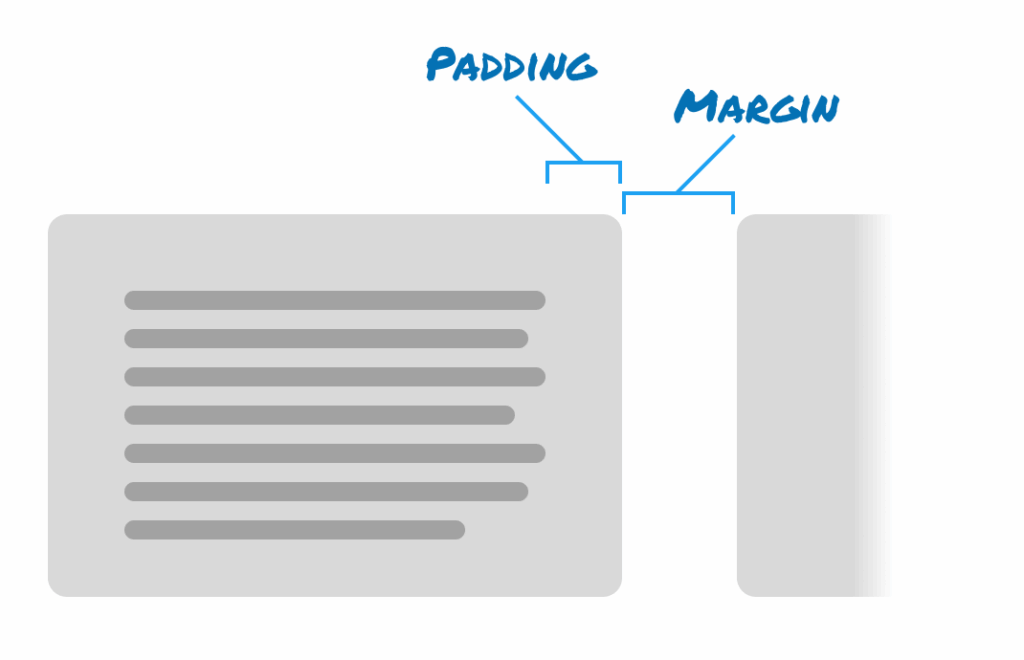
In the world of CSS, there are two different types of spacing between elements:

  1. Margin is the space outside of an element
  2. Padding is the spacing inside of an element
Diagram showing how padding is the space inside a rectangular element and it's contents, and margin is the space outside the element between it and other elements.

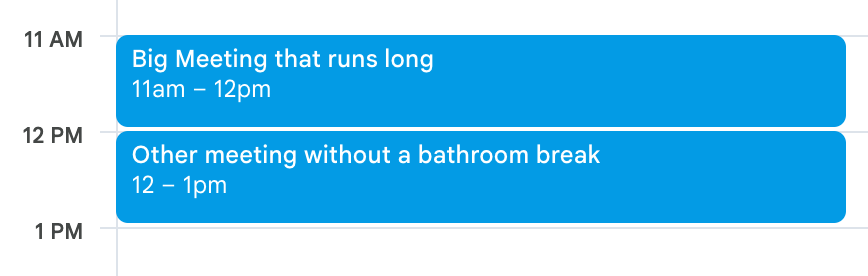
I’ve come to believe that scheduled meetings have MARGIN and PADDING too. Meeting Margin is the space between two meetings. This needs to be explicit. The screenshot below shows two meetings with no margins. They’re bumping up against each other.

Meeting Padding is the space inside a meeting required to make space between other meetings/activities before and after. For example, if I show up immediately after a previous meeting, I’ll still need a minute to find my notes, or run to the bathroom.

Screenshot from Google Calendar showing two meetings running right up against each other. The first is "Big Meeting that runs long" and the second is "Other meeting without a bathroom break"

I try to give meetings Margin so they don’t end up with too much Padding. I try not to put two meetings immediately adjacent on the calendar. I don’t always success.

I wish calendar tools like Google Calendar would make this basic human requirement a bit more obviously part of the flow of booking meetings. Let me know that this meeting runs right into the next one, or that the person I’ve invited has zero minutes between their previous meeting and the one I’m scheduling.


Printers are the new trucks

Everyone knows that if you have a truck, you have a social responsibility to help your friends and family move stuff. It’s in the Bible.

Now, if you have a working printer, you have a social responsibility to help your friends and family print stuff. I humbly accept this responsibility.