
This isn’t typical aov-style material, but this invention is extraordinary (view the video on this page).
Author: Steven Garrity
a tale of cats, philosophers, and SUVs
aov’s favourite philosophy professor, Tony Couture, to whom we owe a lot of our genius, has had quite a misadventure.
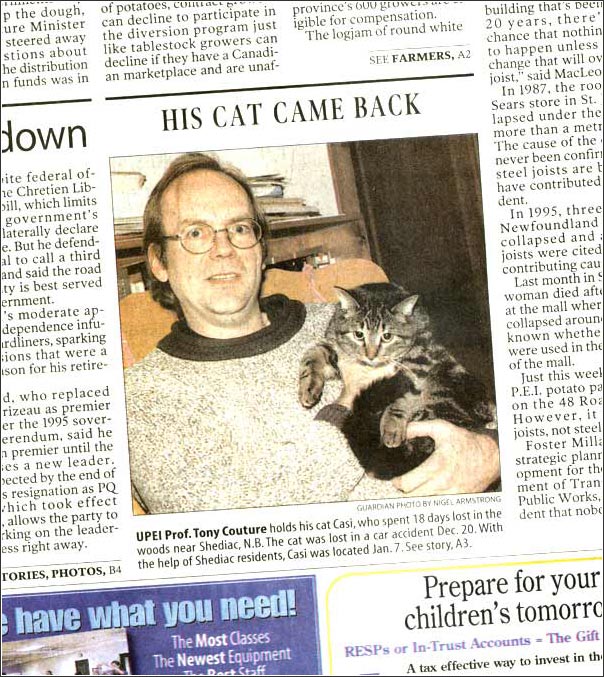
As featured in The Guardian newspaper, Tony’s unreasonably large Sport Utility Vehicle went off the road near Shediac. While Tony seems to have escaped unscathed, the windows smashed and his cat, Casi, went missing. After 18 days lost in the woods a few good Samaritans tracked down the cat and he was delivered home safely.
Tony, we’re glad to hear you are ok and that Casi made it home safely.
After my earlier post about how the news is never pertinent to me, this is refreshing.
no rails will be ‘jibbed’ this day
Two of my co-workers took the day off to go snowboarding today (we are web designers after all). After getting out of bed especially early and a embarking on a tumultuous drive we arrived at the hill. Alone. The hill was closed.
Well, we weren’t totally alone. There was a staff lady in the lodge (which was locked). She was nice to us (who wouldn’t be, we must have looked pathetic).
With no lift operating, we walked up the hill (which should you an idea of how big the hill is). I had what I think might have been a stoke (I will confirm this on WebMD in a few minutes). We had one beautiful run on powder and corduroy*. Just enough to remember how much fun it is, then back to work.
* “Corduroy” is a term used to describe the snow after it has been freshly groomed and still has the little corduroy-like ridges from the groomer. It’s a beautiful thing.
Linkin’ Logs from 37signals
We are honoured to be in such good company on the Linkin’ Logs page at 37signals.com (which has been recently “refined” and looks great).
In the news today: something bad has happened to somebody, somewhere.
I have noted to those around me on occasion that I find it interesting that “the news” has never been pertinent to my life in any way. With the simple exception of the local weather (which is inevitable anyway), no news story on the radio, from the newspaper, or on television has ever pertained to me enough to require any action or illicit a response of any kind on my part.
While curious, I never paid much attention to this somewhat bizarre phenomenon. However, today I was reading Neil Postman’s Amusing Ourselves to Death. In the book, Postman puts forth the proposition than in the previous century, our public discourse was shaped by the medium, print, into a discourse of reason and that the public discourse of this century has been shaped by the medium, television, into a discourse of superficial nonsense.
While exploring the concept of decontextualized news (basically everything that comes from the Associated Press, with anonymity of both author and audience) Postman asks:
“How often does it occur that information provided you on morning radio or television, or in the morning newspaper, causes you to alter your plans for the day, or to take some action you would not otherwise have taken, or provides insight in to some problem you are required to solve?”
Good question Mr. Postman. The answer is never.
A discussion of ‘skins’ strangly free of sexual innuendo.
Prompted by a post on KirbyFerguson.com about Winamp, I will now rant about skins:
For those of you that don’t know, “skins” is a term used to describe a program that can have many different appearances (colors, shapes, etc.). Winamp is the ultimate ‘skinable’ program. It pioneered the skinable program. The trouble is, skins are evil. Let me explain.
When an operating system is being designed (think MacOS 9 and X, Win9x/2k, BeOS, etc.), a relatively significant number of talented user interface experts design a complete set of interface controls including buttons, dialogs, sliders, inputs, displays, etc. On most major operating systems, these graphical items are brilliantly designed. Sure, you may get bored of looking at the same ones all the time, but they were designed to be looked at for a long time. They are good.
Now Johnny programmer wants his new program to look as cool as he does. If he uses the boring old default Windows controls, how will the world know that he is totally x-treme? This is where skins appear.
Perhaps the idea is somewhat more innocuous in its origin than I have suggested. The idea of letting the end user (a mysterious beast as far as many programmers are concerned) customize their program seems like a neat idea. They can have they program look like they want it to.
The trouble with customization is that most end users can’t handle their new found power. Joe Winamp user never spent 2 year with test subjects perfecting the most intuitive possible slider control. The other major problem is consistency. You may have noticed that every time you press “Save As…” in a major program, you get a similar looking dialog box. This way, you don’t have to learn a new dialog in every program since they all perform the same function.
Winamp isn’t the worst skinable program out there since the controls change appearance, but for the most part, remain the same size and in the same place, preserving at least some level of consistency.
Programs like Sonique allow you to have the program shaped however you like, putting the controls in any arrangement. Even Microsoft, who of all companies you would think would appreciate the value of consistency since they built the OS themselves, has jumped on the bandwagon. Their latest version of Windows Media Player is as flexible as Sonique. What really kills me about it is that the ‘classic’ skin, which looks like the old version of Media Player with the default windows controls is actually just a normal skin like any other made up of bitmap images that fake the appearance of the default Windows controls. If I worked on default Windows controls at Microsoft, besides being much wealthier than I am now, I would be irate.
Another big culprit in the new skinable world is the Mozilla project (or Netscape 6, don’t ask what happed to Netscape 5, it went the way of Microsoft Word versions 3, 4, and 5). Mozilla’s browser is totally based on skins and does not rely at all on the the operating systems default controls. This makes it ugly and slow (bitmap images use far more memory than the default OS controls).
Mozilla claims to have a good excuse for using skins rather than operating system controls. It allows them to develop for more operating systems with much less customization and it allows a consistent user experience across different platforms. The problem with this noble sounding idea is that most users don’t use more than one operating system. Much more important than consistency between Mozilla on Windows and Mozilla on Linux, a switch most users don’t make at all and a few do occasionally, is consistency between Mozilla on Windows and Microsoft Word for Windows, a switch many people make a hundred times a day.
I would love to have a version of Winamp, which, as Kirby said, is a fast and stable program, build on the default OS controls. I would also like to see similar a version of the Mozilla browser (fortunately it’s open source and someone is working on this).
Ahh… I feel better now. Thank you.
re: bovine balladeers.
moo.
e-commerce is out. u-commerce is in.
Earlier in the year I was talking with a co-working about the hype surrounding e-commerce and the more recent m-commerce (“mobile commerce” – cell phones, PDAs, etc.). I put forth a proposition that soon enough, we’ll be able to buy anything we want in the context in which it arises. For example, if I’m watching TV and Chandler has a nice Gap sweater on (a scenario that arises more often than you’d think), I will be able to buy it right then, right there. If you are walking down the street and someone rides by with a kitbag you like, you’ll be able to order it, right then, right there (don’t ask me how, that’s not important).
While I’m sure this isn’t a particularly original idea, I thought I was quite clever at the time and semi-sarcastically coined the term u-commerce (ubiquitous commerce). While browsing Signal vs. Noise today, I discovered that VISA has appropriated my idea, and called it “universal” commerce.
I suspect their focus groups probably said, “males and females ages 7 to 58 don’t know what ‘ubiquitous’ means”.
some discouraging words followed by some encouraging images
The dark side:
The bright side:
- explodingdog.com (don’t worry, it’s not exploding dogs, it’s great illustrations)
vanity domains galore
Registering your-own-name.com is something we’ve all thought about it. I think matt even tried once, but was too late.
Kirby Ferguson, formerly of IslandEdition.com fame, will now be referred to as KirbyFerguson.com.
Keep an eye on the site over the next while.