Acts of Volition in 2002: A statistical review

2002 saw Acts of Volition slip from being a multi-author weblog to a paltry 1-1/2 author weblog. While this may have cut the volume of posts, the participation of readers has been great. Writing for AoV has started to feel less like traditional writing and more like having a conversation with the readers.

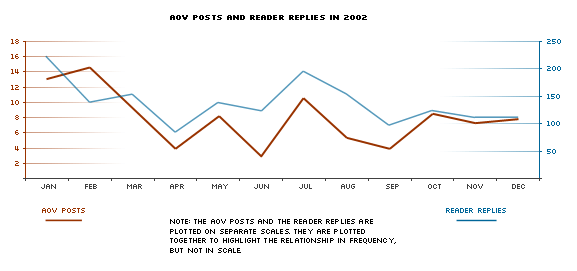
This chart shows the relationship between aov posts and readers replies over 2002 (note – the chart is a little misleading – the two lines are charted on separate scales).

Here is Acts of Volition in 2002 in numbers:

Posts Replies Replies per Post Posts per Day Replies per Day
January 16 180 11.25 0.53 6.00
February 10 202 20.20 0.33 6.73
March 11 131 11.91 0.37 4.37
April 6 55 9.17 0.20 1.83
May 10 114 11.40 0.33 3.80
June 9 40 4.44 0.30 1.33
July 14 146 10.43 0.47 4.87
August 11 75 6.82 0.37 2.50
September 7 55 7.86 0.23 1.83
October 9 118 13.11 0.30 3.93
November 8 101 12.63 0.27 3.37
December 8 109 13.63 0.27 3.63
Total 2002 119 1326 11.14 0.33 3.63
Red bold type indicates the highest figure per column.
Blue bold type indicates the lowest figure per column.
* The NX Petition was only available for the first few days of November.
 

Year-end and Christmas Stuff

Despite advice to the contrary, I hereby confess my weakness for Dave Barry humour. I even own one of his books (which lead to much confusion as it caused my father to laugh out loud while giving blood).

Despite the use of a poorly formatted bullet list, I did enjoy Dave Barry’s Year in Review.

From March:

… on the music front, the U.S. recording industry is buoyed by a report that 14-year-old Jason Plempitt of Knoxville, Tenn., went into a music store and actually purchased a CD, making him the first teenager in three years to pay money for a recording, rather than download it for free from the Internet. The humiliated youngster quickly informs his classmates that his computer is broken.

A pleasant Christmas has left me with some new stuff, including:


Bullet lists of Good and Evil

I’m working on getting out of this glass house so I can throw more stones. In the meantime, a great pet-peeve of mine is bullet lists that don’t indent properly when lines wrap.

A stupid bullet list:

• Divitias alius fuluo sibi congerat auro et teneat culti iugera multa soli,quem labor adsiduus uicino terreat hoste.
• Martia cui somnos classica pulsa fugent: me mea paupertas uita traducat inerti, dum meus adsiduo luceat igne focus.
• ipse seram teneras maturo tempore uites rusticus et facili grandia poma manu.

A smart bullet list:

  • Divitias alius fuluo sibi congerat auro et teneat culti iugera multa soli,quem labor adsiduus uicino terreat hoste.
  • Martia cui somnos classica pulsa fugent: me mea paupertas uita traducat inerti, dum meus adsiduo luceat igne focus.
  • ipse seram teneras maturo tempore uites rusticus et facili grandia poma manu.

As the principal at a local high school used to say over the PA-system: You know who you are, whoever you are!


Crusaders for health

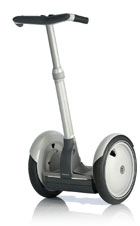
I fear that people would pelt me with rocks and garbage if I rode around town on this thingA recent article from SFWeekly argues in favour of a ban by the San Francisco city council of the Segway from sidewalks and bike paths with the argument that people need more exercise. This has been one of the most common criticisms of the Segway; that it will allow lazy people to avoid even more much needed exercise.

First, I imagine that for many people, the Segway would replace the car for short drives more often than it would replace walking. For example, I have about a 7 minute drive to work, but it would take at least 30 minutes to walk. Should I walk? Maybe – but if so, then you should eat more vegetables (read: mind your own business).

I’m not going to walk a half hour to work everyday. Maybe I’m lazy – but I’m just not going to do it. I would take a Segway to work. Surely taking a Segway to work would be better than driving (fresh air, far more energy efficient).

The argument that Segway’s are bad because they will prevent exercise seems to me to stand atop a slippery slope. Should we not use remote control on our TVs and VCRs because they keep us on our asses?

It has always struck me as odd that we pay people to mow our lawns (and shovel our driveways here in Canada), and then pay to work out in gyms. I’ve always thought that all those people in gyms could be mowing my lawn. It would be a win-win situation (synergastic!). That said – I don’t think we should ban ride-on lawnmowers and force people to mow their own lawns.

To be fair, most people I’ve heard argue that Segways will be bad for our health don’t take the argument so far as to suggest that they should be banned as a result.

I should also acknowledge that the author of the SFWeekly article was likely trying to provoke debate and responses like this one – fair enough. The author refers to the Segway as “ultimate American doomsday machine” and deems it a “national threat at least as grave as Iraq”. He’s clearly trying to ruffle feathers with hyperbole.

While, as a geek, I am enamoured with the Segway from the bits I’ve seen online, I don’t think the biggest hurdle for the device will come from municipal law or health concerns. Rather, my biggest concern about owning a Segway would be looking like a huge dork. Though I imagine early roller-bladers would have had to contend with jeers form their four-wheel-per-foot comrades (“nice rocket boots, future boy!”).

For now, I’ll keep driving myself to work in my five-passenger, 2788-pound car each morning.
 

Bah, Humbug!

I saw a commercial this week that started with a voice-over about a man who thought that Christmas was an excuse to get people to spend their money. Exactly!, I thought.

As the commercial went on, I found myself agreeing more and more with the sentiments of this man.

Then, it said: “Tonight at 8pm, Dicken’s A Christmas Carol“.


Juvenile Art Rock Legally Unleashed

The Creative Commons organization gives artists the tools they need to release their work into the public domain with limitations.

As a nod of support to the organization, my old band, Horton’s Choice, has released our recordings under the Creative Commons Attribution-NonCommercial-ShareAlike license. Basically that means that you can use our music for non-commercial use, but you must attribute to work to Horton’s Choice, and any derivative work must also be released under the same type of open licence.

A few things they’ve done well:

I pretend that I think Horton’s Choice was a crappy garage band, but I’m really only using humour to mask my feeling that this was the greatest artistic achievement of my life.


Pot Logic: Affirming the Consequent

Canada is debating the decriminalization of the personal possession of small amounts of marijuana. I heard a representative of a police association on the CBC the other day make an argument that I recognized from my Practical Logic philosophy course.

Unfortunately, I don’t have a link to the original quote, but the argument was roughly this: 100% of heroin addicts in Canada started with marijuana. The implied premise here is this: therefore, smoking pot leads to heroin use.

This is called affirming the consequent. If A then B. B therefore, A. It’s wrong. All leprechauns drink Guinness. You drink Guinness, therefore you are a leprechaun.

I know this isn’t a new argument, in fact, it’s quite obvious. That’s exactly why I thought it was notable. It was so obviously a logical fallacy that I was amazed that it was stated so simply.

Perhaps we should be teaching the basics of arguments and fallacies in grade school.


Beyond Justice

I have a friend and co-worker who is, among other things, a recovering lawyer (where is there a snare drum and hi-hat when you need it?). Writing about the recent Canadian Supreme Court ruling denying a patent on a genetically modified mouse, he tells me that “each ruling usually has a key paragraph upon which it turns.”

He was kind enough to cut through the 30,000+ word ruling for us and send the following key excerpt. It’s fascinating to see such a formal institution walk the line between the practical and the metaphysical. I think they did well.

163 It also is significant that the word “matter” captures but one aspect of a higher life form. As defined by the Oxford English Dictionary, supra, vol. IX, at p. 480, “matter” is a “[p]hysical or corporeal substance in general…, contradistinguished from immaterial or incorporeal substance (spirit, soul, mind), and from qualities, actions, or conditions”. “Matière” is defined by the Grand Robert de la langue française, supra, vol. 4, p. 1260, as “[TRANSLATION] “corporeal substance `that is perceptible in space and has mechanical mass'”. Although some in society may hold the view that higher life forms are mere “composition[s] of matter”, the phrase does not fit well with common understandings of human and animal life. Higher life forms are generally regarded as possessing qualities and characteristics that transcend the particular genetic material of which they are composed. A person whose genetic make-up is modified by radiation does not cease to be him or herself. Likewise, the same mouse would exist absent the injection of the oncogene into the fertilized egg cell; it simply would not be predisposed to cancer. The fact that it has this predisposition to cancer that makes it valuable to humans does not mean that the mouse, along with other animal life forms, can be defined solely with reference to the genetic matter of which it is composed. The fact that animal life forms have numerous unique qualities that transcend the particular matter of which they are composed makes it difficult to conceptualize higher life forms as mere “composition[s] of matter”. It is a phrase that seems inadequate as a description of a higher life form.


Canada: Let’s splurge on health care

I’ve intentionally avoided posting about politics and policy here on Acts of Volition over the past two years. I’ve done this mostly because I don’t like hearing other people’s half-baked arguments, and figured people didn’t want to hear mine. We’ll, I’m not sure why this situation is any different, if it is at all, but grant me some leeway, it won’t happen often.

Today, Roy Romanow released his government-commissioned royal commission report on the state and future of health care in Canada. The ridiculously short summary of the results go something like this (note: I haven’t actually read the report yet – I’m just relying on journalists):

Public health care is good; let’s pay for it.

I completely agree. The classic demands on government go something like this: more stuff, less tax. Politicians (if you’ll permit my gross generalization) are infamous for promising just that. However, let me be at least one person who’s willing to say I want more stuff, and I’m willing to pay for it. I want a strong public health care system and if you need to, raise my taxes.

The most common response I hear to increasing taxes for funding programs like health is that there is so much waste in government, that they should clear that up and they would need to increase taxes. This is probably true (again with the gross generalizations), but it’s a crutch. It’s not going to happen tomorrow. Health spending and general inefficiency in government are two separate issues. We need to pay for the health care we want.

In his introductory remarks, Romanow stated that medicare is a “moral enterprise, not business venture” – that speech writer should get a raise.

Some links and references for those interested in the report: