These photos of the space shuttle Atlantis passing in front of the Sun are astounding.
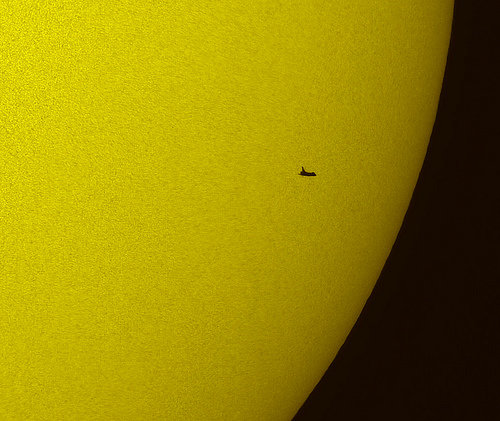
These photos of the space shuttle Atlantis passing in front of the Sun are astounding.
I’ve noticed that my lovely wife has an interesting process when composing email. She actually reads what she’s written before she sends it. It goes something like this:
This is in contrast to my technique:
I wonder how my life would be different if I actually read my emails before I sent them.
We made a cool tech demo of some new Video features from the upcoming Firefox 3.5 (which is required to view the demo, of course).
 View the Demo(Firefox 3.5 beta required)
Recommended watch: Four-part documentary for the CBC, The Great Food Revolution, about the food industry and culture.
The new Wolfram|Alpha “computational knowledge engine” is fun to play with. My favourite response so far comes from a search for Prince Edward Island:
Assuming “Prince Edward Island” is an island | Use as a volcano instead
While the system is remarkable, I’m sceptical that a resource like this can flourish in the hands of a private corporation. If the policies for data inclusion and curation are not open, the validity of the results will suffer.
As a non-historian (like you, I suspect), it seems to me that the views of great minds of the last few hundred years are often garnered from private letters they had written or received. Maybe it was C.S. Lewis writing to J.R.R. Tolkien (probably about who had the best initials), or Thomas Jefferson’s exchanges with John Adams. Presumably, these letters are left behind to family, who eventually choose to share them with the public.
I wondered, then, what will come of the enormous mass of hidden human knowledge (and noise) that is email. When I die (Ray Kurzweil be damned), I will have left tens of thousands of emails locked up on a server. Most will be of no interest to anyone. Some will include private information about myself, my family, or others. I imagine, though, that there are some exchanges in there that might have some value to someone. It’s not my legacy that I’m wondering about though – it’s those email exchanges by much greater minds.
I wondered, then, if digital artifacts, like email and photos should eventually fall into the public domain. Not during the authors lifetime. Not even for years after. Only after enough time for family and friends – those who might be affected by the contents of such correspondence – to pass on. 50 years? 100 years?
It’s not an issue of licensing and privacy (I’m sure smarter people than myself have figured that issue out long ago regarding private letters). Rather, it’s an issue of access and permanence of technology.
Imagine if the Lincoln letters were trapped in a datacenter somewhere in a password protected abe_prez_16@earthlink.net account. Maybe when we die, our digital assets should be copied into a time-release digital safe-deposit box. In 100 years, we learn what Obama was sending from his blackberry, and what you and I thought about the time in which we live.
Maybe I’ll just start CC’ing a copy of all of my email to The Future.
A clever fundraiser from the open source media player, Miro: you can adopt a line of code and watch it mature.
While I often delight in how bad the headlines on CNN are, it’s nice to see someone is actually doing a good job. Jakob Nielsen writes about how the BBC has the best written headlines on the web.
The following things in my house have a clock. Notice that only one of them is actually a clock:
Also see the list of things in my house with lights.
This is what 1,000 frames-per-second looks like (via Digg).